
Global shipping is facing an immediate supply chain crisis. Following joint US and Israeli strikes on Iran, the Iranian Revolutionary Guard Corps (IRGC) has officially closed the Strait of Hormuz, a critical chokepoint for international ocean freight and energy markets.
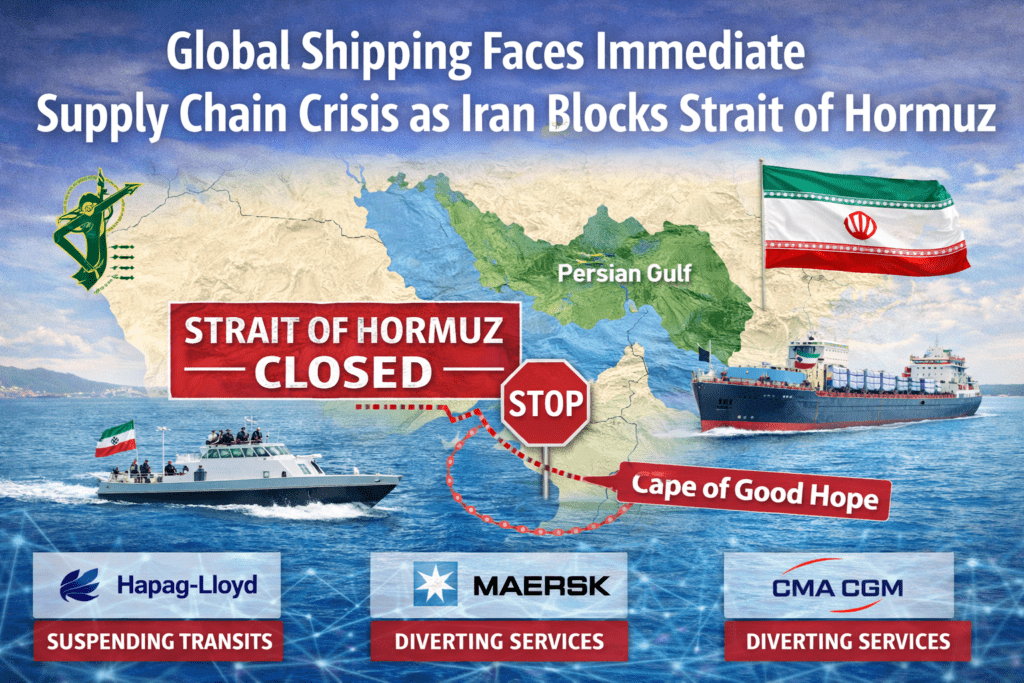
The IRGC has announced a full blockade, broadcasting that no ship may pass under any circumstances. This closure traps vessels currently inside the Persian Gulf and completely cuts off major regional hubs, such as Jebel Ali, from global trade networks. Because there is no maritime alternative to the Persian Gulf, the blockade has created a hard deadlock for both container and energy flows.
In response to the closure and the escalating security environment, major container lines are prioritizing crew and cargo safety, rapidly reversing their 2026 plans to return to the Suez Canal:
- Hapag-Lloyd: Has suspended all vessel transits through the Strait of Hormuz until further notice, citing the official closure of the waterway and mandatory safety precautions.
- Maersk: Confirmed it is diverting its ME11 and MECL services around the Cape of Good Hope rather than transiting the Red Sea.
- CMA CGM: Has shelved its plans to return the FAL1, FAL3, and MEX services to the Red Sea, pointing to the highly uncertain international context.
This blockade creates a critical bottleneck that will severely disrupt global supply chains. Shippers must immediately prepare for:
- Severe Port Congestion: Hubs like Jebel Ali are effectively paralyzed. Vessels cannot enter or exit the Gulf.
- Extensive Cargo Rerouting: Carriers will likely discharge cargo at alternative regional ports outside the Gulf, relying on overland road networks to move shipments where infrastructure permits.
- Extended Transit Times: Diverting vessels around the Cape of Good Hope adds approximately 10 to 14 days to most Asia-Europe and Asia-US East Coast routes.