
Recent missile and drone strikes on key gas facilities in Qatar have severely disrupted the country’s energy output, cutting its liquefied natural gas (LNG) export capacity by roughly 17%.
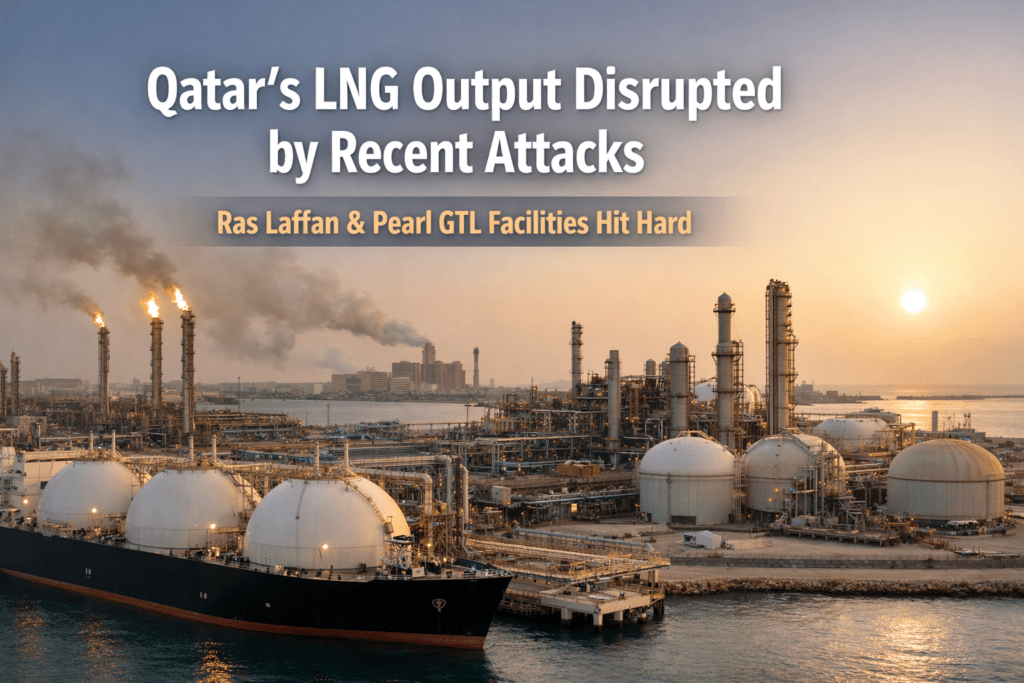
The attacks directly targeted Ras Laffan Industrial City, one of the world’s largest LNG hubs. QatarEnergy confirmed that two of its 14 LNG trains,Train 4 and Train 6 sustained heavy damage.
Together, these units produce approximately 12.8 million tonnes of LNG annually out of Qatar’s 77 million tonne total capacity. Additionally, one unit at the Pearl gas to liquids (GTL) plant was hit and is expected to remain offline for at least a year.
The damaged LNG trains are partially owned by ExxonMobil, which holds a 34% stake in one unit and 30% in the other. The Pearl GTL facility is operated by Shell.
The financial and operational fallout is massive. The disruption is projected to cost Qatar around $20 billion annually.
QatarEnergy chief Saad Sherida Al-Kaabi announced that the company will have to declare force majeure on select long term contracts, halting agreed LNG volumes to buyers in Italy, Belgium, South Korea, and China.
Depending on the regional security situation and how quickly repair operations can safely commence, the disruption and rebuilding efforts could last between three and five years.
Beyond LNG, Qatar expects significant drops in other critical EXIM exports:
- Condensate exports: Down 24%
- Helium: Down 14%
- LPG: Down 13%
- Naphtha and sulphur: Down 6% each
These strikes are a direct retaliation following Israeli attacks on Iran’s gas infrastructure, including the South Pars Gas Field. In response, Iran has targeted energy facilities across the Gulf and warned of further strikes if its own infrastructure is hit again.
Consequently, the damage has stalled Qatar’s ambitious plans to expand production from the North Field, the world’s largest gas reserve. Work on the expansion project has slowed significantly, with delays of more than a year now looking probable.