
This year’s Indian budget is quietly trying to fix the “middle” of India’s supply chain.
This is the critical leg between the factory and the port. The strategy is clear: shift more domestic cargo onto rail and water to free up the roads for time-sensitive EXIM shipments.
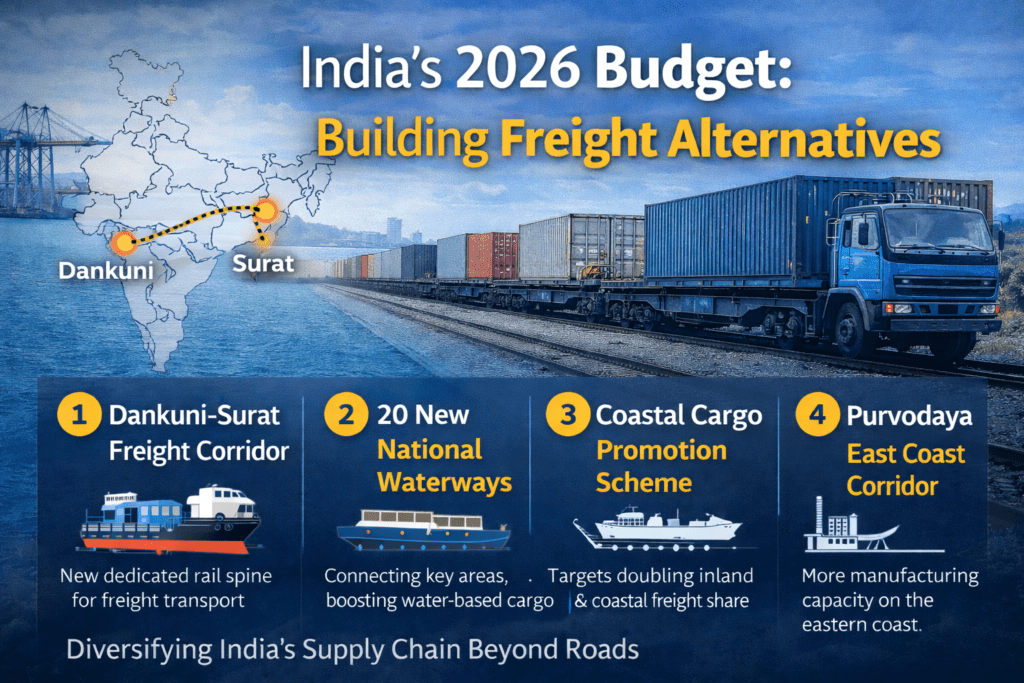
The budget’s approach is to create alternate freight capacity.
1) A new freight spine: Dankuni to Surat
A new dedicated freight corridor being built to connect Dankuni (East) to Surat (West).
This has indirect benefit : fewer trucks competing for the same roads, fewer last-mile pileups, and more stable evacuation from port clusters.
2) 20 new National Waterways + ship repair ecosystem
The budget also talks about operationalising 20 new National Waterways connecting mineral-rich areas, industrial centres, and ports.
This Benefits in:
- Bulk domestic cargo (coal, steel, cement, agri) can move by water more often
- That reduces road pressure around industrial belts
- Ports and ICDs get breathing room during peak cycles
3) Coastal Cargo Promotion Scheme: 6% → 12% by 2047
This is the most “port-adjacent” announcement: a push to double the share of inland waterways + coastal shipping from 6% to 12% by 2047.
India wants a larger chunk of domestic freight to move by water.
4) Purvodaya: East Coast Industrial Corridor
Purvodaya is framed as an “Integrated East Coast Industrial Corridor.” In plain terms: more manufacturing + movement capacity along the east coast, which can reshape routing decisions for exporters over time.