
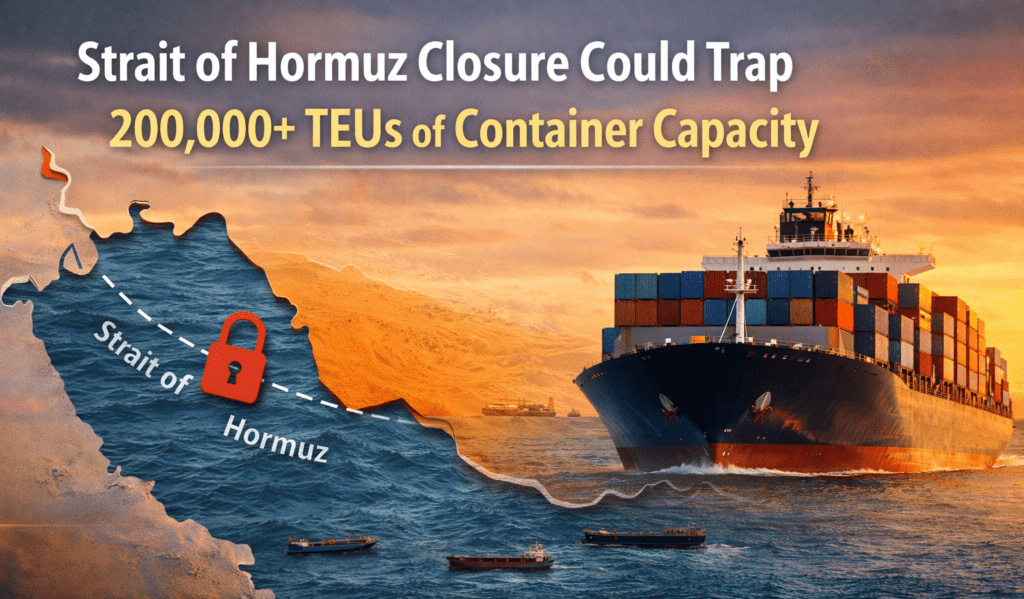
A potential closure of the Strait of Hormuz could trap more than 200,000 TEUs of deep sea container capacity inside the Persian Gulf. According to a new Sunday Spotlight report from Sea Intelligence, a network stress test reveals how shutting down this strategic waterway would severely disrupt global ocean freight.
The Sea Intelligence analysis focused exclusively on deep sea vessels scheduled to depart the Persian Gulf, leaving out local feeder services.
If all vessels followed their published schedules perfectly without a single delay, a baseline minimum of 156,074 TEUs of capacity would be trapped in the Gulf. However, ocean freight rarely operates on perfect schedules. When analysts factored in typical operational delays using historical vessel data, the restricted capacity jumped to 204,159 TEUs.
Beyond the immediately stranded cargo, closing the strait would create massive network disruptions. Vessels already en route to the Persian Gulf would be forced to cancel or alter their rotations. This diverted cargo would flood alternative transhipment hubs outside the Gulf.
Ports like Salalah, Colombo, and Singapore would absorb sudden spikes in volume. This redirection would likely increase yard density at these terminals, drag down productivity, and cause berthing delays for mainline vessels operating on entirely different trade lanes.
For ocean carriers, the Persian Gulf functions primarily as a net import region. This means deep sea services departing the Gulf are largely responsible for repositioning massive volumes of empty containers back to Asian manufacturing hubs.