
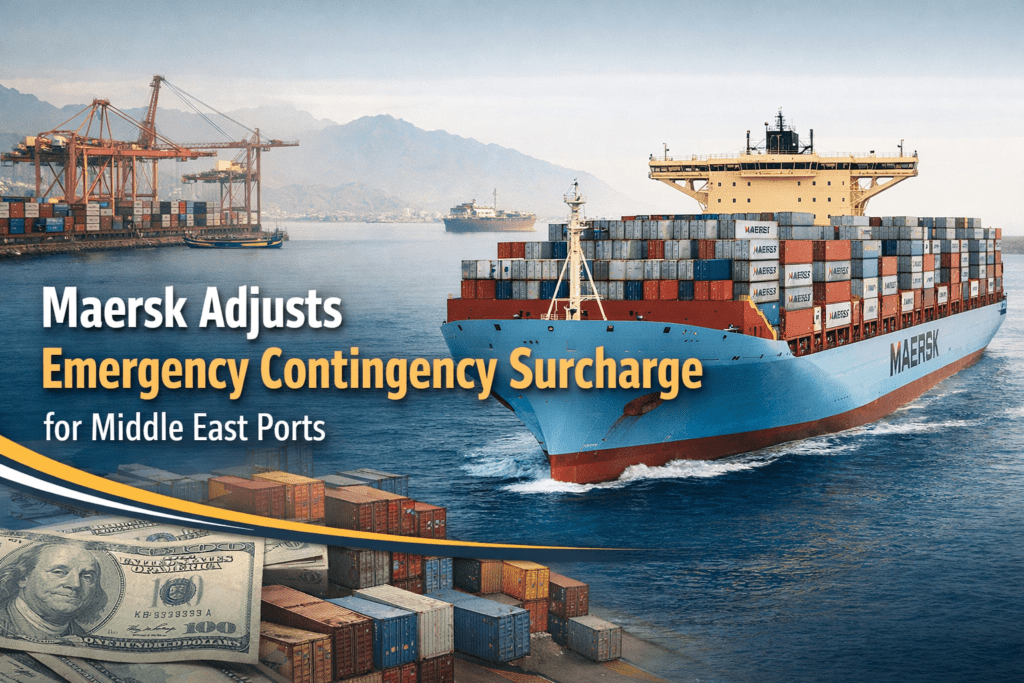
Maersk has announced critical adjustments to its Emergency Contingency Surcharge (ECS) for freight moving from multiple global origins to key Middle East ports.
As military conflicts escalate and disrupt regional shipping, the carrier is updating its surcharge structure to offset rising operational costs and network constraints.
The updated ECS targets cargo destined for Khor Fakkan in the United Arab Emirates and Sohar in Oman. The implementation timeline depends strictly on the trade lane:
- Non FMC Trades: Effective March 17, 2026, based on the Price Calculation Date.
- FMC Regulated Trades: Effective April 17, 2026 (includes the US, Puerto Rico, Guam, Taiwan, and Colombia) after a 30 day notice period.
- Vietnam Trades: Effective April 2, 2026, following a 15 day notice period.
The revised surcharge applies to shipments originating from major global regions, including North America, Europe, Africa, Oceania, and South America. Shippers can expect the following adjusted rates:
- 20 foot dry container: USD 1,800
- 40 foot dry and high cube container: USD 3,000
- 20 foot reefer container: USD 1,900
- 40 foot high cube reefer container: USD 3,800
- 45 foot high cube container: USD 3,000
These exact surcharge levels will also apply to special equipment, including out of gauge, shipper owned, and non operating reefer containers.
In a related move, Maersk confirmed that these identical ECS levels and timelines will also apply to refrigerated cargo and special equipment shipments bound for other Middle East gateways. This includes Oman (excluding Sohar) and major Red Sea ports like Aqaba in Jordan, as well as Jeddah and King Abdullah in Saudi Arabia.
Maersk noted that cargo already in transit remains completely unaffected by this update. The carrier will review the ECS regularly and adjust, extend, or withdraw the surcharge as operational conditions in the Middle East evolve.