
COSCO Doubles Down on Methanol Shipping as Maersk Pulls Back
COSCO’s container arm OOCL has named the OOCL Wisdom at Nantong on May 8: the world’s largest methanol dual-fuel containership, and the first of 12 ultra-large methanol vessels from a $2.9 billion order COSCO placed in 2022.
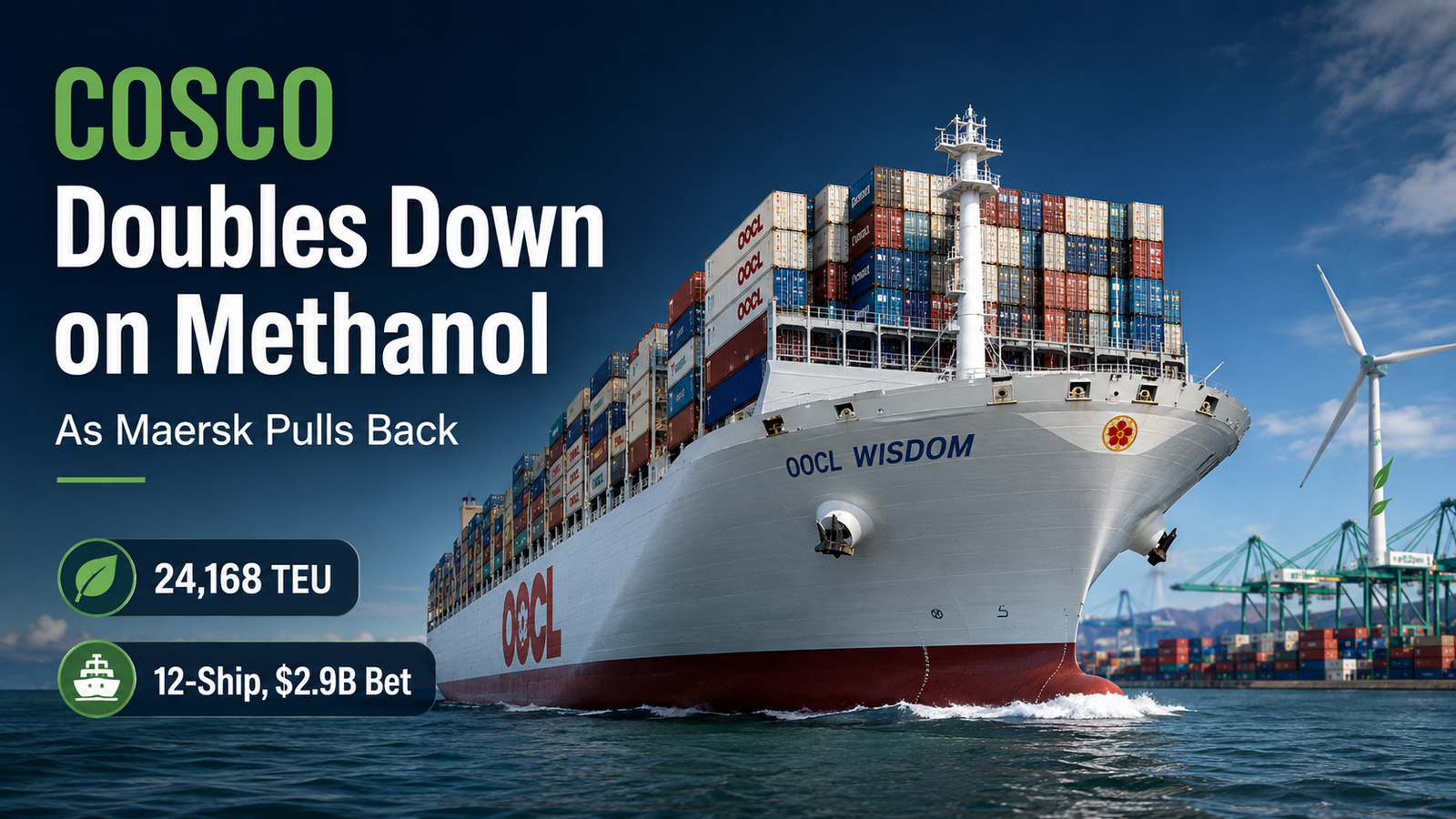
The naming ceremony lands as the methanol-shipping bet diverges across the top carriers. Maersk has slowed its methanol push, citing concerns about green-methanol supply and bunkering infrastructure. COSCO has done the opposite. DNV data puts the global methanol dual-fuel containership fleet at 70 vessels in service today, with another 180 on order. Containerships are now the largest single category of methanol-fueled ships.
The vessel
OOCL Wisdom is 399 metres (1,309 feet) long, with a deadweight of 225,000 tonnes and a service speed of 22.7 knots. Capacity is 24,168 TEU, the figure that makes it the largest methanol dual-fuel containership built so far.
The propulsion stack matters more than the headline size for the green-shipping story: the main engine, auxiliary engine, and boilers are all dual-fuel capable, running either methanol or conventional bunker fuel. OOCL says this is the largest methanol dual-fuel propulsion system installed on any ship.
OOCL also flags the digital layer onboard:
- An intelligent data platform with real-time ship-shore information exchange
- An energy-efficiency management system with automatic speed and trim optimisation
- Real-time prediction of hull structural fatigue damage
CEO Tao Weidong called the vessel “a new benchmark for our vessel technology” and framed it within OOCL’s commitment to green, low-carbon, digital, and sustainable operations.
The 12-ship orderbook behind it
OOCL Wisdom is the first of 12 ultra-large methanol vessels COSCO Shipping ordered in 2022 for just under $2.9 billion, with deliveries running into 2028. Of the 12:
- 7 are being built by Nantong COSCO KHI Ship Engineering (NACKS), assigned to OOCL
- 5 are being built by Dalian COSCO KHI Ship Engineering (DACKS) for the COSCO brand
This sits on top of an existing methanol fleet. The 16,163 TEU class led by COSCO Shipping Yangpu (366 metres, 11,000 cubic metres of methanol storage) is sized to complete a one-way Far East to US East Coast voyage on methanol alone. The four ships in that class (Yangpu, Carnation, Panama, and Lily) were completed earlier this year.
COSCO has also ordered 16 more 12,000 TEU methanol newbuilds, and converted the 20,000 TEU COSCO Shipping Libra to dual-fuel methanol operation.
ALSO READ:Kandla Port Conducts India’s First Methanol Bunkering Trial
Why methanol drives ultra-large ship design
The core challenge with methanol as a bunker fuel is energy density: it carries roughly a third of the energy of conventional fuels per unit volume. That forces shipyards to design oversized fuel tanks, which costs cargo capacity.
COSCO’s response has been to build big. The 11,000 m³ tank on the 16,163 TEU class is what makes the one-stop Far East to US East Coast voyage possible. The same logic carries into the 24,168 TEU class: larger hulls absorb the methanol-tank penalty without crippling cargo capacity.
Maersk, by contrast, has slowed its methanol push, citing concerns about green-methanol supply and bunkering infrastructure. The two carriers are now running different bets on the same alternative fuel.
The orderbook ratio (70 methanol containerships in service, 180 more on order, per DNV) means the fleet will more than triple if every committed ship delivers. The question is whether green-methanol supply scales with it. The number to track over the next 12 months is global green-methanol production capacity announced for 2026 to 2028, against the bunker demand implied by these vessels at full utilisation. If supply lags, COSCO’s bet looks bolder. If it catches up, Maersk’s caution looks expensive.