
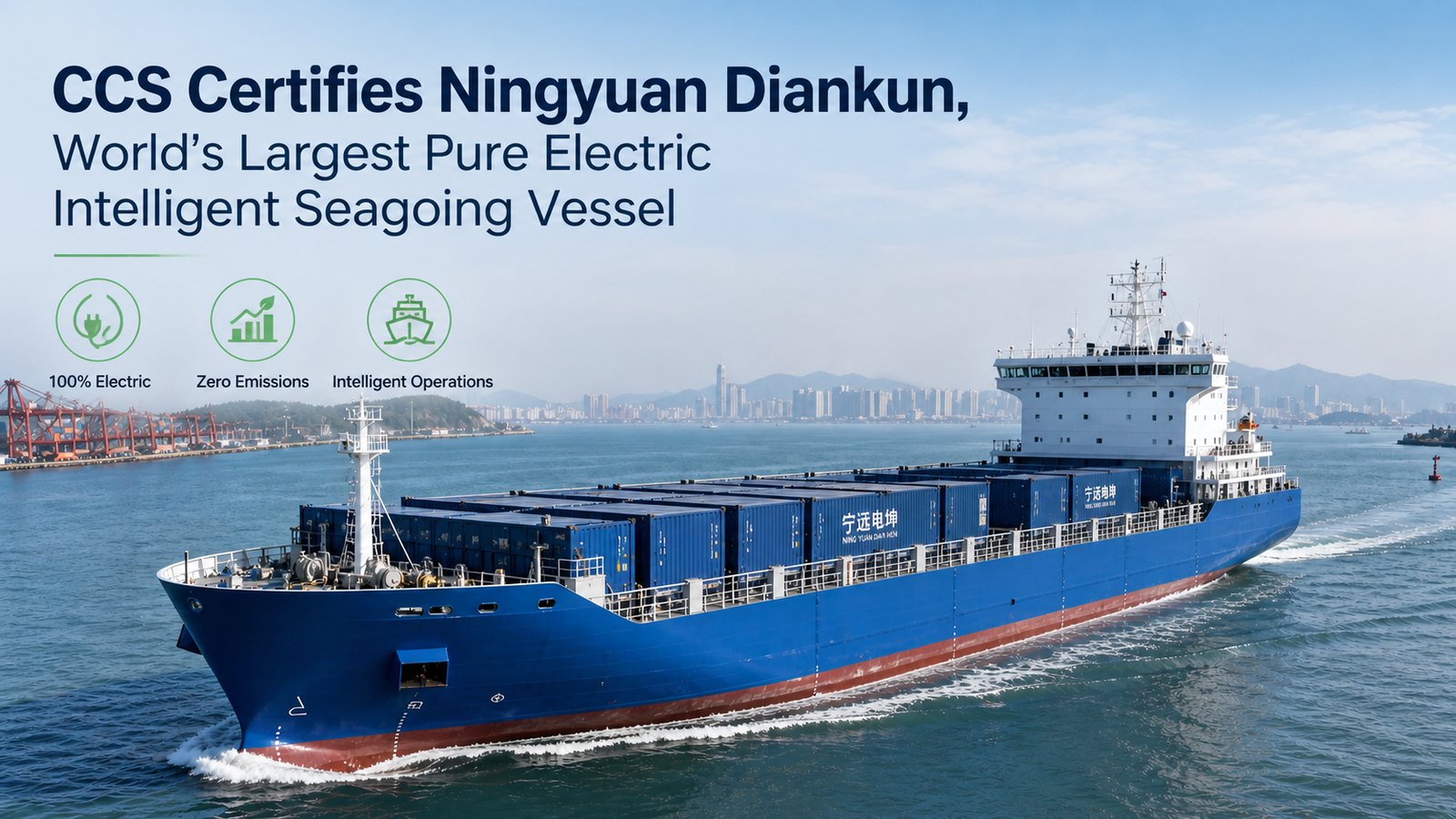
China Classification Society (CCS) has completed the construction survey and certification of Ningyuan Diankun, which it describes as the world’s largest pure electric intelligent seagoing vessel and China’s first high end ship in this category.
The certification adds to China’s broader push toward greener shipping and more advanced maritime technology.
Vessel specifications
Ningyuan Diankun is a 740 TEU open-top container ship measuring 127.8 metres in length. It is owned by Ningbo Ocean Shipping Co., Ltd. and built by Jiangxi Shipbuilding Co., Ltd.
The ship uses a twin-engine, twin-propeller configuration with a top speed of 11.5 knots. That puts it firmly in the short-sea and coastal container transport segment.
Fully electric propulsion
The vessel runs entirely on electric power. Its primary energy source is a set of 10 containerised battery units. To keep turnaround times practical at port, it is built to support both high-voltage shore power charging and rapid battery swapping.
A photovoltaic system has also been installed onboard for additional energy generation. According to CCS, this combined setup enables zero-emission operations.
Emissions impact
CCS estimates Ningyuan Diankun will cut around 1,462 tonnes of CO2 emissions per year compared to a conventional fuel powered ship of similar size.
ALSO READ:China – World’s No. 1 Shipbuilder with Record 2025 Order Book
Intelligent ship systems
Beyond propulsion, the vessel carries the CCS i-ship (M, No, I) notation, which reflects a high level of onboard automation and system integration. Its integrated platform supports real-time route optimisation, situational awareness, and continuous equipment monitoring, all aimed at improving day-to-day operational efficiency and overall vessel management.
CCS provided technical support throughout the project, covering design reviews and discussions on key engineering aspects. Its involvement extended across the full construction phase, ensuring compliance with safety and technical standards before delivery.