
India’s free trade cover now spans 38 countries across nine deals. The UK and Oman agreements go live in 2026, the EU pact in 2027
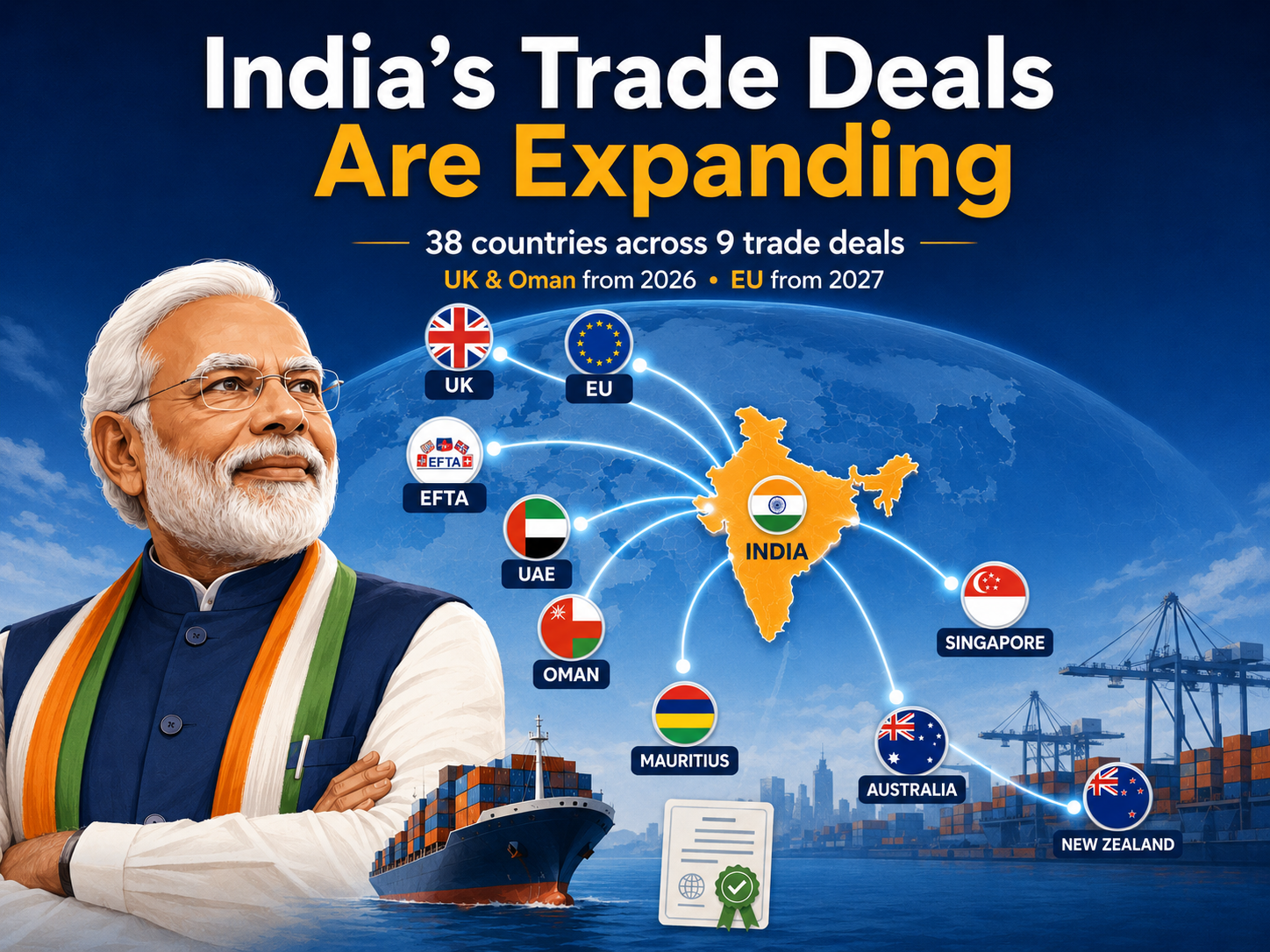
Three of the nine deals are the ones that matter right now
The India UK Comprehensive Economic and Trade Agreement (CETA) was signed in July 2025 and is expected to take effect in the first half of 2026. It gives 99 percent of Indian exports duty-free entry to the UK.
The India Oman Comprehensive Economic Partnership Agreement (CEPA), signed in December 2025, targets a 1 May 2026 start and opens 98.08 percent of Oman’s tariff lines, covering 99.38 percent of Indian exports by value.
The big one, the India EU agreement signed in January 2026, is still in Brussels ratification and unlikely to bind before early 2027.
The EFTA deal took effect in October 2025, New Zealand goes to zero on every line once its agreement starts, and the UAE and Australia pacts have run since 2022.
Value content of 35 to 45 percent decides who qualifies
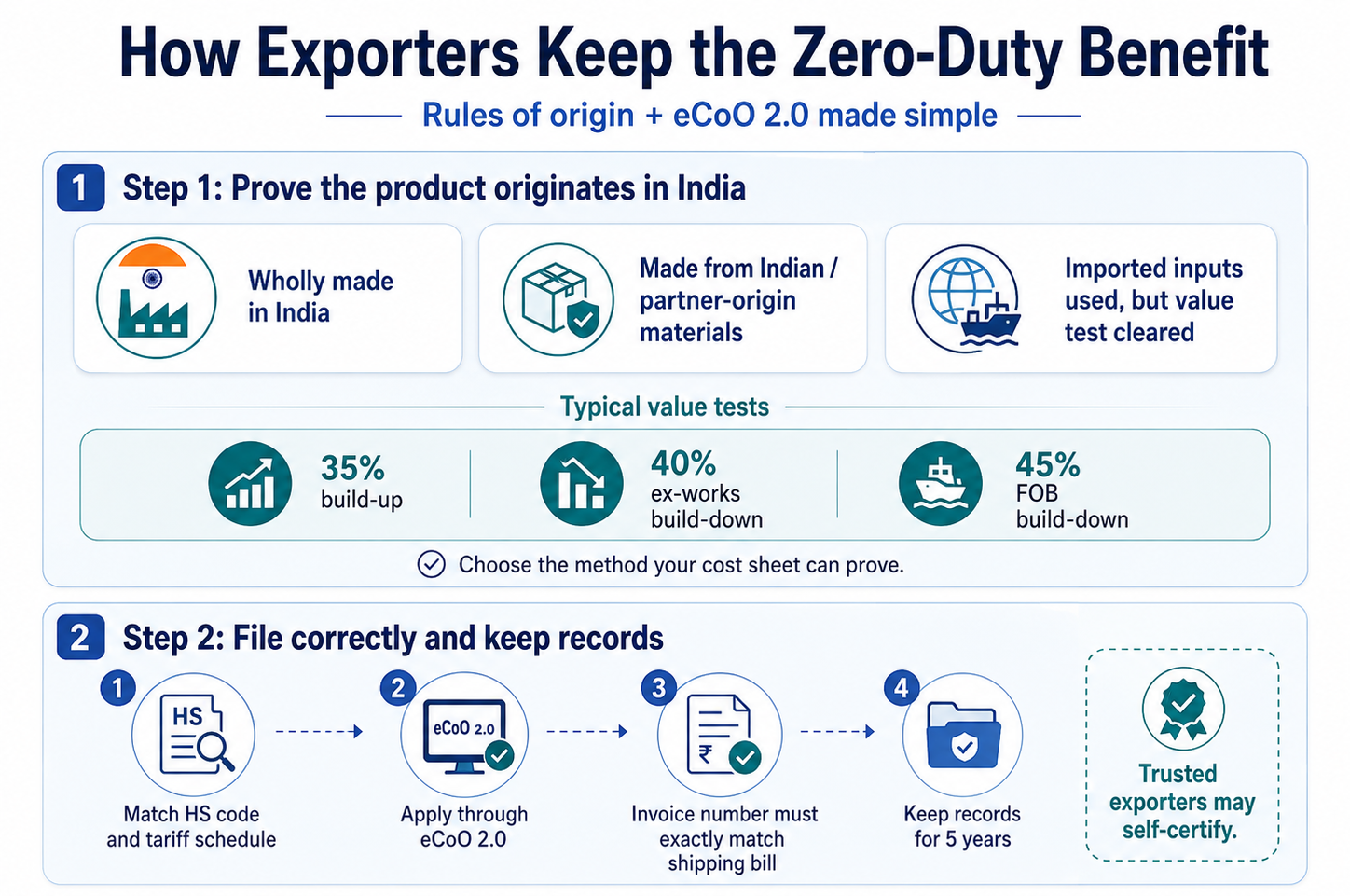
A product earns its zero duty one of three ways under CETA. It is wholly made in India or the UK. It is built entirely from materials that already originate in either country. Or it uses some imported inputs but still clears the value test. Most factory goods take the third route, and the threshold runs three ways depending on how you count. The build up method asks for 35 percent local value. Build down on the ex works price asks for 40 percent. Build down on the FOB price asks for 45 percent. You pick the one your cost structure can prove, and you prove it on a cost sheet that travels with the application.
Why does the line sit there at all?
A deal that zero rates 99 percent of trade only works if the goods are genuinely made in the partner country. Drop the threshold and the agreement becomes a side door for everyone else. A Vietnamese shirt routed through Tirupur with a new label would ride into the UK duty free on India’s deal. Hold the line at 35 to 45 percent and the value has to actually be added here. The number is doing border control, not bookkeeping.
Textiles get a little slack on top. Up to 10 percent of fibre by weight can come from outside and the product still qualifies, as long as that imported material sits under a different heading from the finished good.
eCoO 2.0 is the only door now
Since 1 January 2025, every Certificate of Origin has to be filed online through the new eCoO 2.0 platform, There is no paper channel.
To file, an exporter needs three things lined up. A current Importer Exporter Code. A digital signature linked to that code, or the Aadhaar based e-sign the upgrade now allows. And a registered account on the portal under the same code. The system already clears more than 7,000 certificates a day across 125 issuing agencies, so the machinery works. The friction is upstream, in whether the exporter’s own paperwork holds together.
The invoice numbers have to match, and that is the new trap
In April 2026, DGFT changed the rules under Notification 05/2026-27. Two changes bite. The invoice number on the Certificate of Origin now has to match the number on the shipping bill. Exactly. The system checks it automatically and bounces anything that does not line up. The second change lets large, trusted exporters certify their own origin instead of going through an agency, which rewards the firms that have earned it and tightens the trail for everyone else.
Then there is the long tail. Records have to be kept for five years, and UK and EU customs can ask for proof inside that window. If the cost sheet does not back the value you claimed, or the invoice numbers do not match, the importing country cancels the preference and claws back the duty. Sometimes with a penalty on top.
Anyone who lived through the UAE deal in 2022 has seen this film. In the first year, plenty of exporters could not produce the cost sheets to support their claims, and the preference went unused. By 2024 the big houses had it sorted. The small ones were still leaving money on the counter.
What this means for compliance teams
This can be classified into four parts.
1)Match every product you export to its HS code and check the partner country’s schedule on the Trade Connect tariff tool.
2)Settle on one value method and document your inputs by origin.
3)Register on eCoO 2.0 and apply for trusted exporter status if your volume earns it.
4)Then build the five year record system before you need it, not after a customs query lands.
The firms most exposed are the small textile, leather, gems and engineering exporters. They are also the ones the agreements were sold to help the most. That is the quiet contradiction in every Indian trade deal of the last decade.
eCoO 2.0 already clears 7,000 certificates a day. That number roughly doubles once the UK and Oman agreements switch on in 2026. The exporters who have their value math, their matching invoice numbers and their five year paper trail ready before then will keep their preferences when EU customs starts checking in 2027. The duty break is real.