
The United Kingdom and the Netherlands have signed a £2.4 billion deal to build eight amphibious transport ships, splitting the class four apiece and building all of them in British shipyards to a Dutch design.
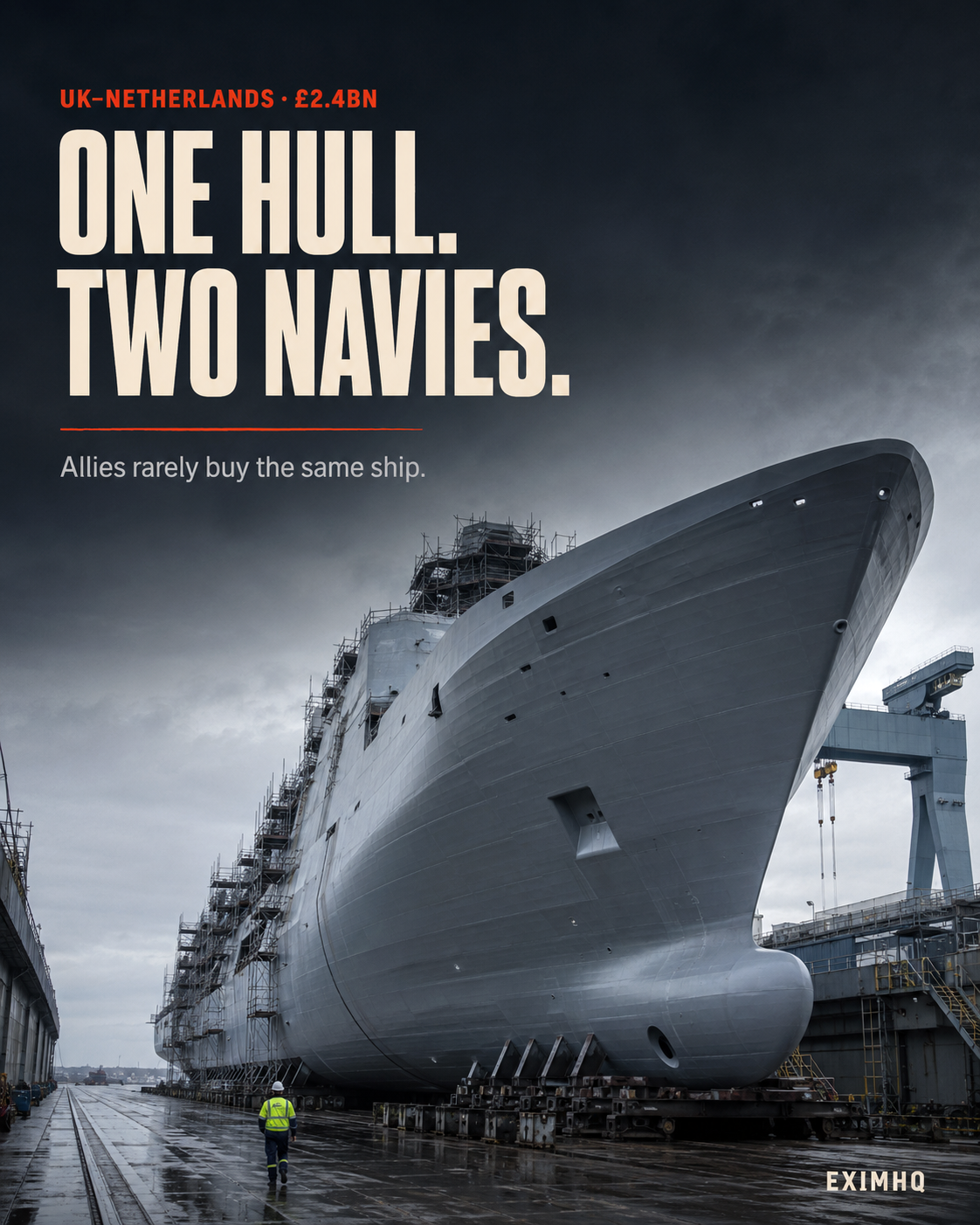
The agreement was signed on 7 July by UK Prime Minister Keir Starmer and Dutch Prime Minister Rob Jetten at a meeting of NATO leaders in Ankara. It lands as European governments push money into defence at a pace not seen in a generation, and it ties two of the continent’s closest naval partners to a single hull for decades.
British yards will build all eight amphibious transport ships
The eight amphibious transport ships will be built in UK shipyards alongside Dutch industry, based on a Dutch design, with the United Kingdom and the Netherlands each taking four. Each ship runs 160 metres long and displaces 15,000 tonnes, sized to carry troops, military vehicles, equipment and drones. The programme is set to support hundreds of high skilled jobs across British yards.
The ships are meant to become the backbone of the joint UK-Netherlands amphibious force the platforms that put marines, vehicles and kit ashore.
Flight decks are built for drones the Royal Navy does not yet fly
Each ship’s flight deck is designed to operate both current and future long-range drones and autonomous systems, part of the Royal Navy’s shift toward a hybrid fleet. That fleet, set out in the UK’s Defence Investment Plan, pairs conventional warships with autonomous surface and undersea drones rather than swapping one for the other.
The partnership goes past the hulls. Britain and the Netherlands have agreed to cooperate more closely on autonomous and uncrewed technology, the systems both navies expect to carry into the next decade of operations. Designing a flight deck around aircraft that do not exist yet is a bet. Navies that have placed it before have usually been right.
ALSO READ:UK Govt. introduces sanctions and use control regulations.
The deal deepens Europe’s longest-running integrated force
The agreement builds on more than 50 years of cooperation through the UK-Netherlands Amphibious Force, described as Europe’s longest-running integrated military force. Operating the same class of ship, the Royal Navy and the Royal Netherlands Navy will be able to train, deploy and operate together with far less friction than allies who buy separate hulls and then try to make them work in tandem.
Two navies buying the identical ship is rarer than it sounds. Allied fleets talk interoperability constantly and then order different platforms. Defence Secretary Dan Jarvis put the point plainly, saying the two forces will operate the same equipment “so if they need to, we can fight and win together.”
Both countries are NATO allies and members of the Joint Expeditionary Force, and both said they will keep working together to protect critical undersea infrastructure and deter threats across the North Atlantic and High North. Both back Ukraine.
For UK yards, the order book matters more than the ships
For Britain’s shipyards, the weight of this deal is the pipeline. Eight amphibious hulls land on top of [five Type 26 frigates already ordered for the Norwegian Navy], a programme the government ties to roughly 4,000 British jobs. Shipbuilding skill is perishable: a yard that stops building loses welders, designers and fitters it cannot quickly replace, and every gap in the order book raises the cost of the next ship. Two export-anchored deals in short order are how you keep the line moving.
Britain has now signed two allied shipbuilding deals in quick succession Type 26 frigates for Norway, amphibious ships with the Netherlands and the logic under both is identical: keep the drumbeat steady or pay to rebuild the workforce later. The government has staked its shipbuilding strategy on exactly that, which makes this unlikely to be the last co-build it signs with a JEF partner. Watch the autonomous side. The hulls are the visible half of this agreement. The uncrewed systems the two navies plan to build together are the half that decides whether the hybrid fleet is a fighting force or a line in a plan.