
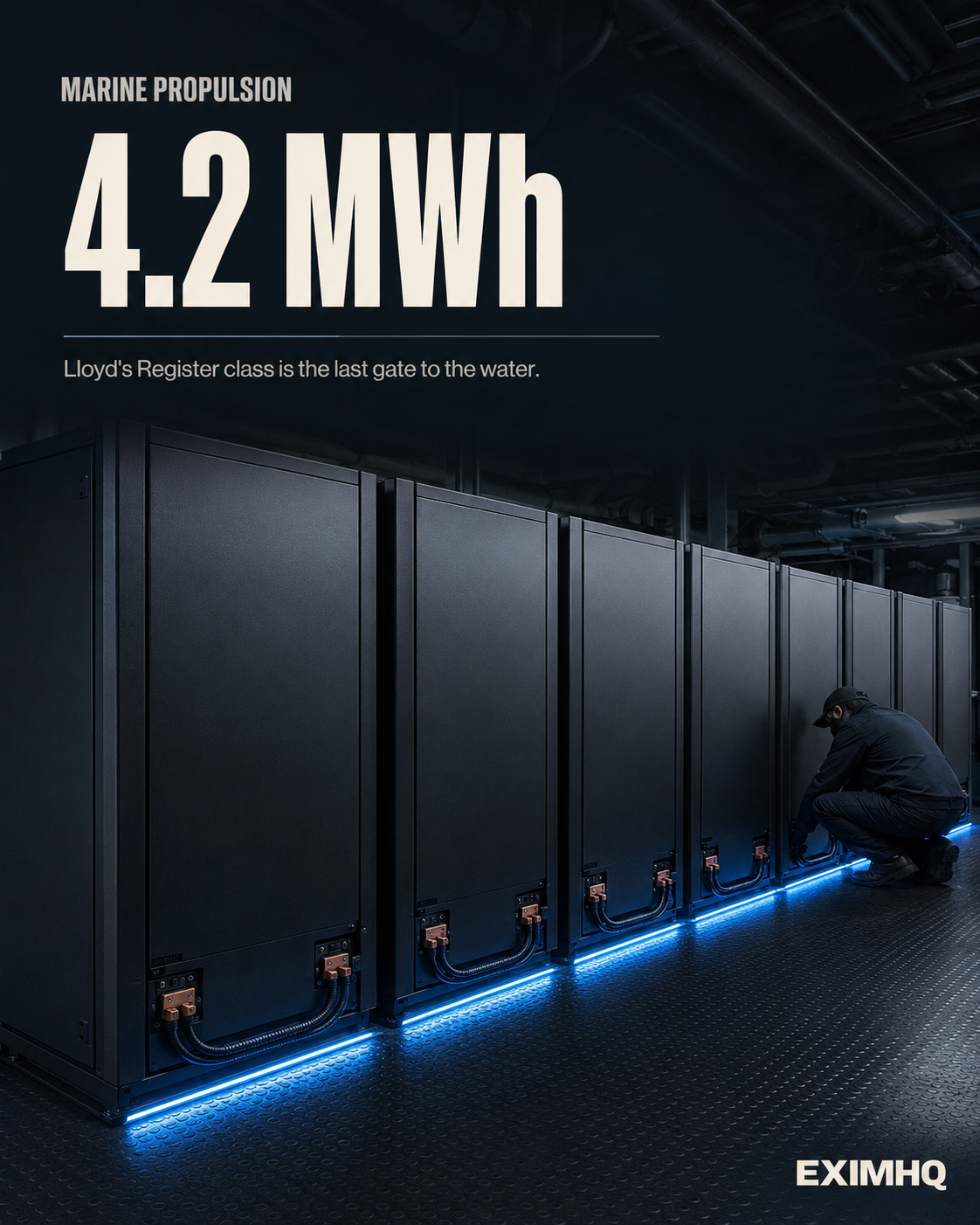
Williams Grand Prix Technologies has launched the ES10M, its first dedicated marine battery system a modular pack for superyachts and explorer vessels that scales from 39 kWh to 4.2 MWh.
Williams builds in Grove, Oxfordshire, on the same site as the Atlassian Williams F1 Team, and it is pulling motorsport battery engineering into a sector that runs on very different rules. Racing rewards peak power for ninety minutes. A superyacht wants steady output, quiet running, and a pack that survives salt, vibration, and years at sea. The ES10M is Williams betting that the first skill transfers to the second.
The ES10M marine battery system scales from 39 kWh to 4.2 MWh on one architecture
Each ES10M module stores 9.8 kWh at 50.4V and weighs 48.8 kg, and the system stacks those modules from 39 kWh up to 4.2 MWh, with voltage running from 201.6V to 907.2V. At module level it delivers 200 Wh/kg gravimetric energy density and 325 Wh/l volumetric density. The single architecture is the point. One module design covers a support vessel’s hybrid propulsion and a large yacht’s full electric drive, which is what lets a shipyard or a refit team specify the same building block across boats that otherwise share nothing.
Williams built the ES10M around a layered safety design
The safety architecture is where a marine battery earns or loses a buyer, and Williams put it at the center of the ES10M. Thermal-grade materials and a chosen cell format work together to limit cell-to-cell propagation, the chain reaction that turns one failed cell into a fire. An integrated gas management system handles controlled venting, routing gas away so crew and engineering spaces stay safe when a cell goes wrong. The pack is built to withstand thermal, vibration, and ingress stress, carries an IP67 rating at module level, and is designed to maritime EMI/EMC standards meaning it is meant to keep working in a wet, electrically noisy engine room rather than a dry test bench.
ALSO READ:China Launches World’s First Modular Battery Swapping Cargo Ship
Lloyd’s Register class compliance is still in progress
Lloyd’s Register class compliance for the ES10M is not finished; Williams lists it as in progress. That single line matters more than any figure on the spec sheet. A battery’s spec sheet sells the pitch. Class approval sells the boat. No serious yard specifies an unclassed energy system into a newbuild or a major refit, because the classification society’s sign-off is what the insurer, the flag state, and the owner’s surveyor all lean on. Until the ES10M has it, the 4.2 MWh ceiling is a capability, not an order.
Watch the Lloyd’s Register date. Williams has the engineering, and its group has form pushing motorsport battery work into other sectors, but the ES10M cannot convert a sea trial into a refit contract until class approval lands. That approval is the gate, and everything Williams wants from this launch sits on the far side of it. Expect the real commercial news to arrive not with this product sheet, but with the certificate.