
Nearly a year after the initial announcement, MSC Mediterranean Shipping Company and U.S. investment group BlackRock have reportedly resumed negotiations to acquire the global port operations of Hong Kong-based CK Hutchison.
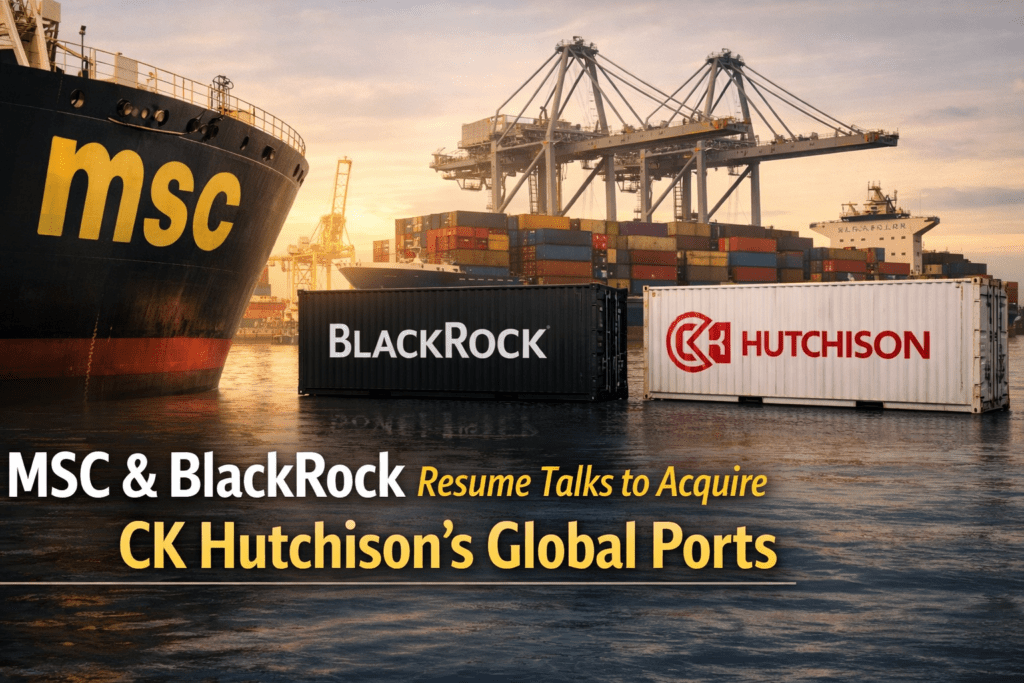
According to the Financial Times, the consortium believes an agreement can finally be reached now that the highly contested Panama Canal terminals have been removed from the equation.
In 2025, the companies initially agreed to a massive two-part deal expected to place a $23 billion valuation on CK Hutchison’s global portfolio (excluding its domestic Chinese operations).
- The Panama Leg: BlackRock was slated to lead the purchase of the Panama Ports Company—which operated facilities at both ends of the Panama Canal with MSC’s Terminal Investment Limited (TiL) acting as a minority investor.
- The Global Leg: MSC was set to act as the lead investor for the remaining 41 port operations spread across 23 countries in Europe, Southeast Asia, and the Middle East.
The original transaction stalled after becoming entangled in a political dispute between the United States and China. China reportedly insisted that state owned COSCO become a partner and potentially control the new company while the U.S. raised national security concerns over Chinese influence at the Panama Canal.
The current breakthrough in negotiations follows Panama’s decision to annul the concession for the Balboa and Cristobal operations. With the Panama assets formally removed, MSC and BlackRock are now pivoting to acquire the remaining 43 terminals worldwide. CK Hutchison, meanwhile, is preparing for an extended legal battle and financial arbitration with the Panamanian government.
MSC is reportedly eager to finalise the acquisition and integrate these assets into TiL’s existing network. As of 2025, TiL already operated over 70 terminals across more than 30 countries, boasting an annual handling capacity of approximately 70 million TEU.
Successfully acquiring the CK Hutchison portfolio would officially position TiL as the world’s largest terminal operator, allowing it to surpass the current leader, PSA, which reported handling 105 million TEU in 2025.