
Sempra Infrastructure’s Costa Azul LNG project loaded its first cargo, sending the Pacific Success out of Baja California for TotalEnergies and giving Mexico its first LNG export terminal on the Pacific coast.
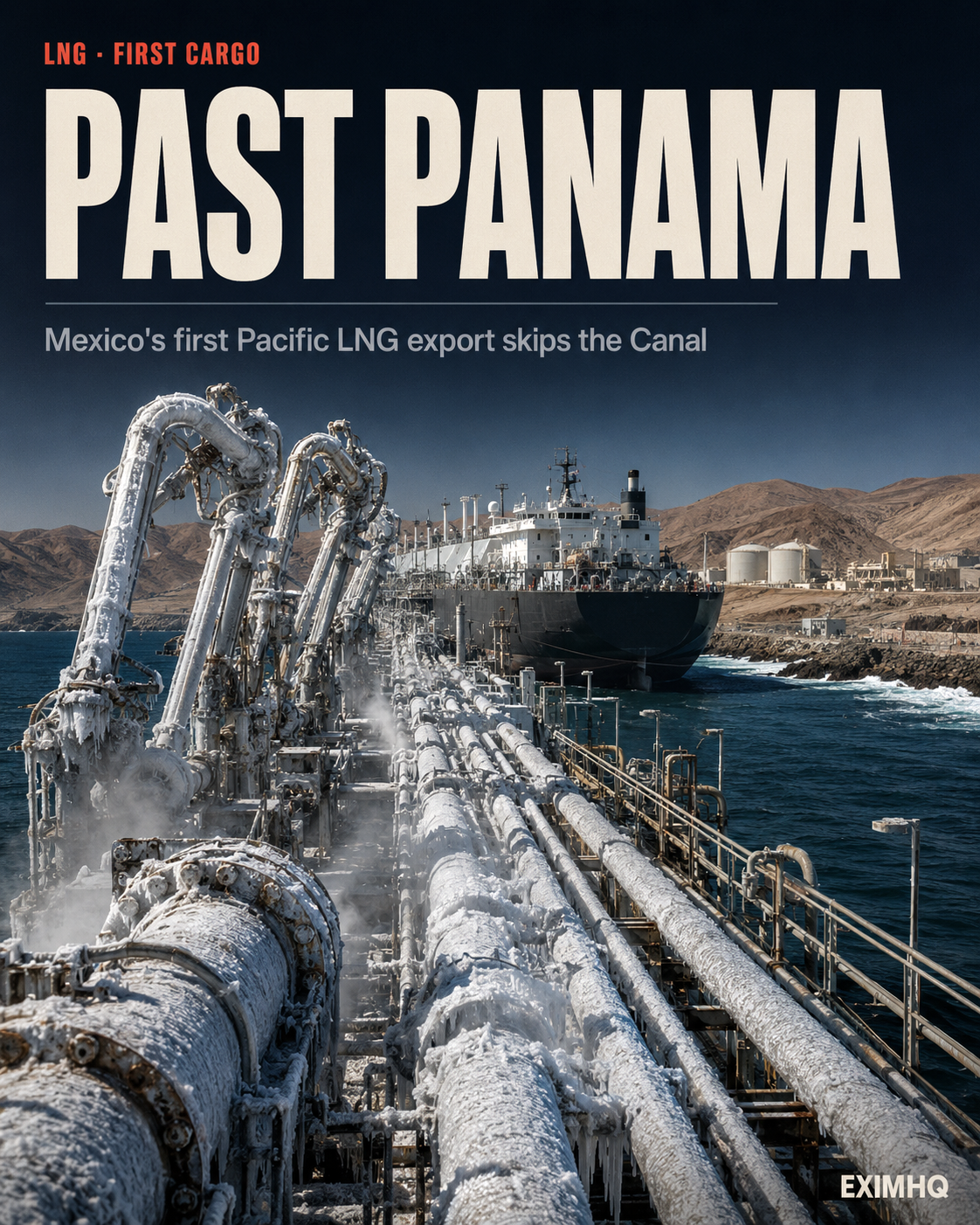
The milestone lands during the plant’s ramp-up, but the location is the story. A terminal on Mexico’s west coast faces Asia directly, and it does so without the one chokepoint that has made Gulf Coast LNG nervous for two years.
Costa Azul LNG opens a Pacific route that skips Panama
Costa Azul is Mexico’s first LNG export site on the Pacific, sited in Baja California with the shortest maritime routes to Asian and Pacific-basin buyers. Its only real competition on that ocean is the export terminals in western Canada. Everything else that serves Asia from the Americas starts on the Gulf Coast, and the Gulf Coast has a Panama problem.
The mechanism is geography, not marketing. A Gulf Coast cargo bound for Asia has one shortcut to the Pacific: the Panama Canal. When the Canal cut transit slots and imposed draft restrictions in 2023 and 2024, low water levels forced some gas carriers to sail around the southern tip of South America instead, adding weeks to the voyage. A Baja terminal never enters that queue. It is already on the right ocean.
Developers pitch every terminal as strategically located. This one actually is the map does the arguing.
ALSO READ:Greek ferry design trades speed for fuel efficiency
Sempra and TotalEnergies own the single-train Phase 1
Sempra Infrastructure operates Costa Azul and holds the majority stake, with TotalEnergies owning 16.6 percent. Phase 1 is a single-train liquefaction facility with a nameplate capacity of 3.25 million tonnes per annum. Roughly 2.5 Mtpa of that is already committed under long-term offtake, 1.7 Mtpa to TotalEnergies and 0.8 Mtpa to Japan’s Mitsui, with TotalEnergies taking every cargo through the ramp-up.
The project reached a positive final investment decision in 2020, the only LNG facility to do so that year, and was built between 2021 and 2025. Commissioning ran through the first half of 2025: Kpler reported the plant began drawing gas in May 2025 under its long-term transport deal with the Rosarito pipeline, then ramped up feed-gas deliveries in June 2025. The first vessel out, the Pacific Success at 88,625 dwt, loaded for TotalEnergies.
Sempra expects substantial completion in the summer of 2026 and treats Costa Azul as the west-coast anchor of a dual-coast portfolio that runs alongside its U.S. Gulf Coast projects. A second, larger phase is under development. Mexico’s only other LNG export terminal sits on the opposite side of the country, in Tamaulipas on the Gulf.
The commissioning gas is flowing and most of Phase 1 is already sold, which means the economics of the first train are largely locked regardless of where spot prices sit this winter. What the market watches now is the second phase. Sempra has staked a dual-coast strategy on the premise that the Pacific arbitrage holds long enough to justify the capital: shorter voyages to Asia, no Canal toll, no drought risk. The Panama Canal’s water problem is structural, not a bad-luck season. As long as that stays true, the case for the larger train builds itself, and the Gulf Coast exporters watching Costa Azul load its first cargo are running the same numbers.