
Fincantieri has agreed a roughly €600 million underwater deal, taking majority stakes in Next Geosolutions, WSense, Graal Tech and Defcomm and pulling all four into a hub that will now span eight companies.
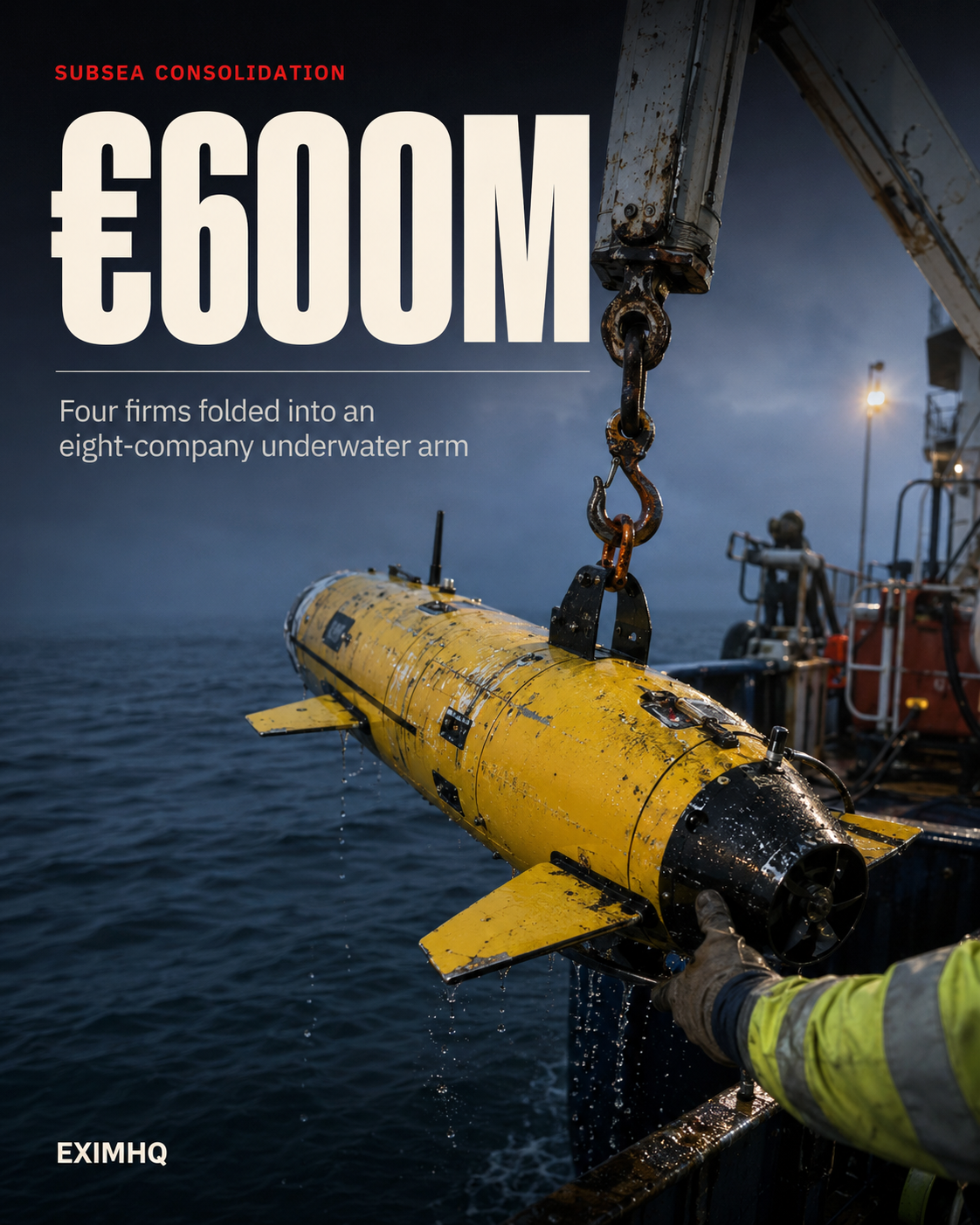
The seabed has quietly become contested ground. Subsea cables carry almost all intercontinental data, offshore wind and oil sit on the ocean floor, and pipelines run for thousands of kilometres with almost nobody watching them. Fincantieri, a shipbuilder known for surface vessels and submarines, is buying its way into that layer.
Fincantieri’s underwater deal folds four firms into an eight-company hub
Fincantieri will route all four acquisitions through its Underwater technological hub, the unit that now coordinates eight companies as a single international operator. The stated logic is vertical integration: rather than selling ships to whoever surveys or protects the seabed, Fincantieri wants to own the survey, the sensing, the robots and the drones as well. CEO Pierroberto Folgiero framed the move as a shift from a builder of platforms into an operator selling end-to-end services, the same pivot naval primes across Europe have been circling for a decade.
WSense and Graal Tech already sit inside Fincantieri’s DEEP system
WSense and Fincantieri have worked together since a December 2023 memorandum, bidding jointly on tenders and wiring WSense’s technology into DEEP, Fincantieri’s demonstrator for protecting subsea infrastructure. Graal Tech’s underwater robots are already built into the same system. So two of the four acquisitions formalise partnerships that were running long before the cheque cleared, which is usually how the cleanest deals in this sector get done. You buy the company you have already learned to work with.
ALSO READ:A.P. Moller to Buy Ocean Yield From KKR
The four firms cover survey, communications, robots and surface drones
Next Geosolutions Europe, set up in 2014 as a venture between Italian entrepreneurs and the shipping company Marnavi, runs the full subsea project cycle: marine survey and geoscience, offshore construction, inspection and repair, and eventual decommissioning across offshore wind, oil and gas, and cable work. WSense, a spin-off of Rome’s La Sapienza University, builds the communications layer, using adaptive wireless underwater modems that hold secure networks together for the Internet of Underwater Things and move data through water where radio signals die.
Graal Tech, out of the University of Genoa, designs modular AUVs and ROVs, the swimming and crawling robots that do the actual work. Defcomm, an Italian start-up, builds the unmanned surface vehicles that sit on top, running proprietary autonomous navigation over satellite and radio links.
What this means for subsea infrastructure protection
For anyone tracking the dual-use defence market, the deal is a bet that the line between commercial subsea services and naval security is disappearing. The same robot that inspects a wind-farm cable can inspect a pipeline someone might want to cut. Buyers on both sides, energy operators and defence ministries, increasingly want one supplier who can survey, sense and act underwater without stitching together five vendors. Fincantieri is assembling exactly that stack, and Graal Tech’s robots already selling into both offshore and defence work under one roof is the tell that the strategy is real, not a slide.
Fincantieri has now committed €600 million and a corporate structure to the underwater sector, which makes retreat expensive and further buying cheap by comparison. The eighth company rarely stops at eight. Expect bolt-on acquisitions to keep coming as the hub fills gaps in its own stack, and expect European rivals with naval and subsea arms to answer, because a full-stack underwater operator on the Adriatic is exactly the kind of thing Naval Group, Saab and Thales cannot afford to let stand alone. The companies that map the seabed, wire it and patrol it are about to be worth more than the ones that merely cross it.