Kongsberg Maritime leads EU wind propulsion project
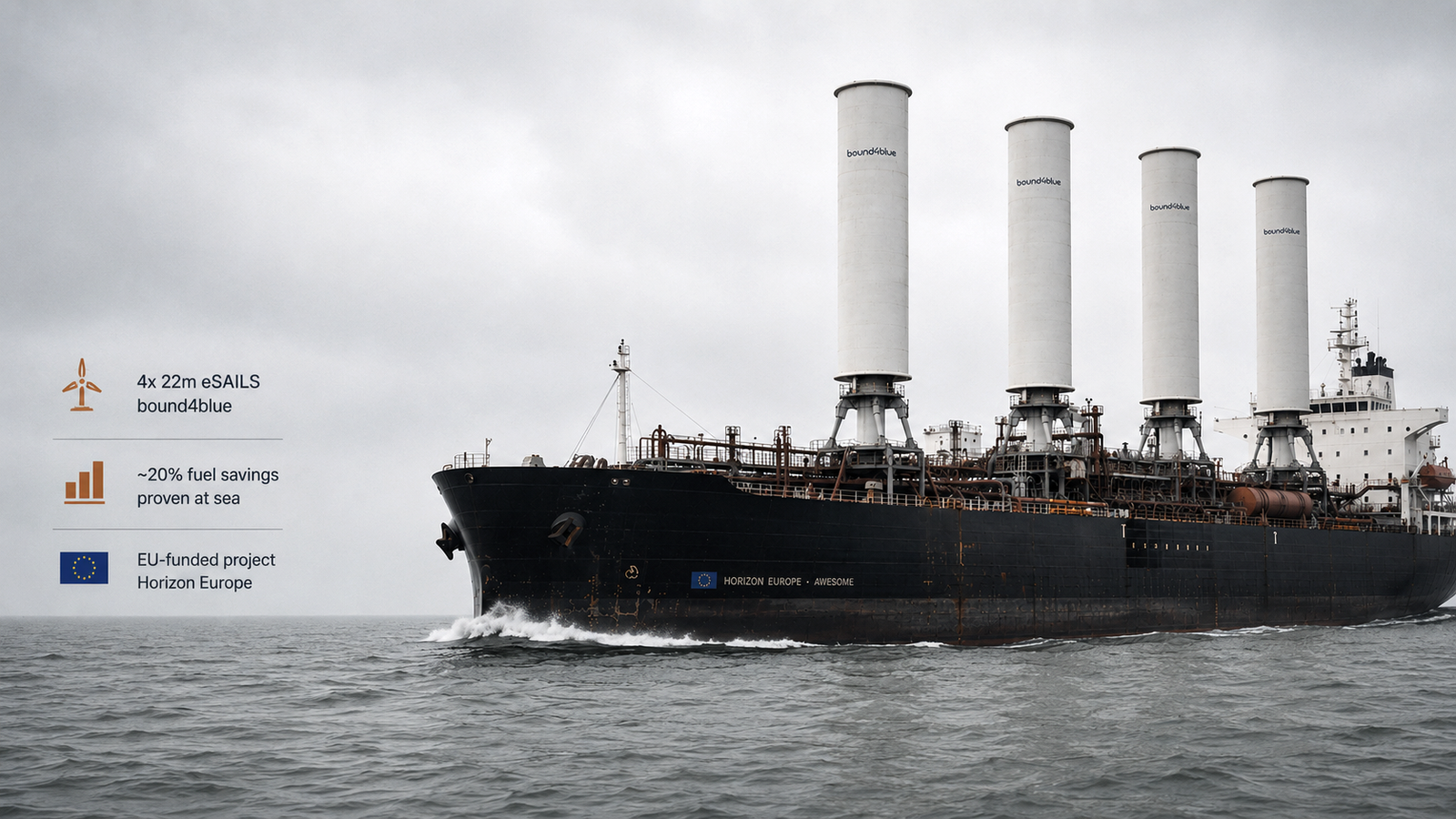
Kongsberg Maritime will lead AWESOME, a Horizon Europe project bringing 15 European partners together to test wind-assisted propulsion at sea and build the tools shipowners need to price the fuel savings.
Wind-assist is not a new idea, and it is not an unproven one.
What has been missing is a way for an owner to know, before signing the retrofit cheque, what those sails will actually save on their own routes. That is the gap AWESOME (Advanced Wind Energy System Optimisation and Monitoring for Efficiency) is built to close.
Two demonstration vessels carry the project’s data load
The project runs on two full-scale ships, not models.
The first is an Odfjell chemical tanker of 49,000 dwt, fitted with four 22-metre eSAIL suction sails from bound4blue. It has already cut fuel use by around 20% on selected voyages. The second is Neoliner Origin, the first hybrid commercial RoRo sailing vessel in service, carrying two 76-metre SOLIDSAIL rigs from Chantiers de l’Atlantique and targeting emissions cuts of up to 80%.
Between them the two vessels cover very different cargo, hull, and route profiles. AWESOME will pull data on thrust, fuel savings, and long-term performance from both, then work out how that performance translates across ship types and operating conditions.
Wind-assisted propulsion’s real problem has never been the wind
The engineering question was answered years ago. A 49,000 dwt tanker saving a fifth of its fuel is not a pilot result that needs defending. The question that stalls adoption is narrower and harder: what a given rig will save on a given trade lane, in a given season, for a given hull and whether that number is solid enough to take to a financier.
Right now most of those numbers come from the sailmakers selling the rigs. Owners discount them accordingly. AWESOME’s deliverable is the measurement and verification tooling that turns a vendor’s brochure figure into a survey an owner, an insurer, and a bank will accept.
“Wind-assisted propulsion is already delivering real results for Odfjell,” said Jan Opedal, project manager at Odfjell. He framed the work as turning operational experience into knowledge the rest of the industry can scale.
ALSO READ:Oaktree ends decade in TORM with $311m Hafnia sale
FuelEU Maritime turns saved fuel into avoided penalty
The timing is not an accident.Both price a ship’s emissions, which changes what a fuel saving is worth. Fuel a vessel does not burn is no longer just a bunker cost avoided. It is emissions the owner does not have to account for under the rules, and where the ship would otherwise fall short, a penalty that does not get paid.
“Wind-assisted propulsion is one of the most attractive pathways to compliant, cost-effective shipping,” said Kjerstin Kleyne Braaten, senior vice president for emerging solutions at Kongsberg Maritime. She called AWESOME a major step toward scaling the technology.
What this means for owners and compliance teams
For a compliance team, the project’s output matters more than its sails. Standardized, documented, independently measured performance data is exactly the input a FuelEU calculation needs and exactly what owners have lacked.
There is a strategic read here too. “Europe is currently a global leader in wind-assisted propulsion technologies,” said Jaap Gebraad, secretary general of the Waterborne Technology Platform, who positioned AWESOME as a way to hold that lead by pooling public and private resources. The rig makers in the project, bound4blue and Chantiers de l’Atlantique, are European. The funding is European. The standard that comes out of this will likely be European first.
Expect the early adopters to be owners on fixed, high-traffic lanes, the routes where a 20% saving compounds voyage after voyage, and where the math makes itself.