
Union shipping minister Sarbananda Sonowal unveiled a ₹5,028.17 crore, 63-project pipeline at Mumbai Port Authority’s 154th Foundation Day on June 25 most of it aimed at waterfront, cruise and energy assets, not container capacity.
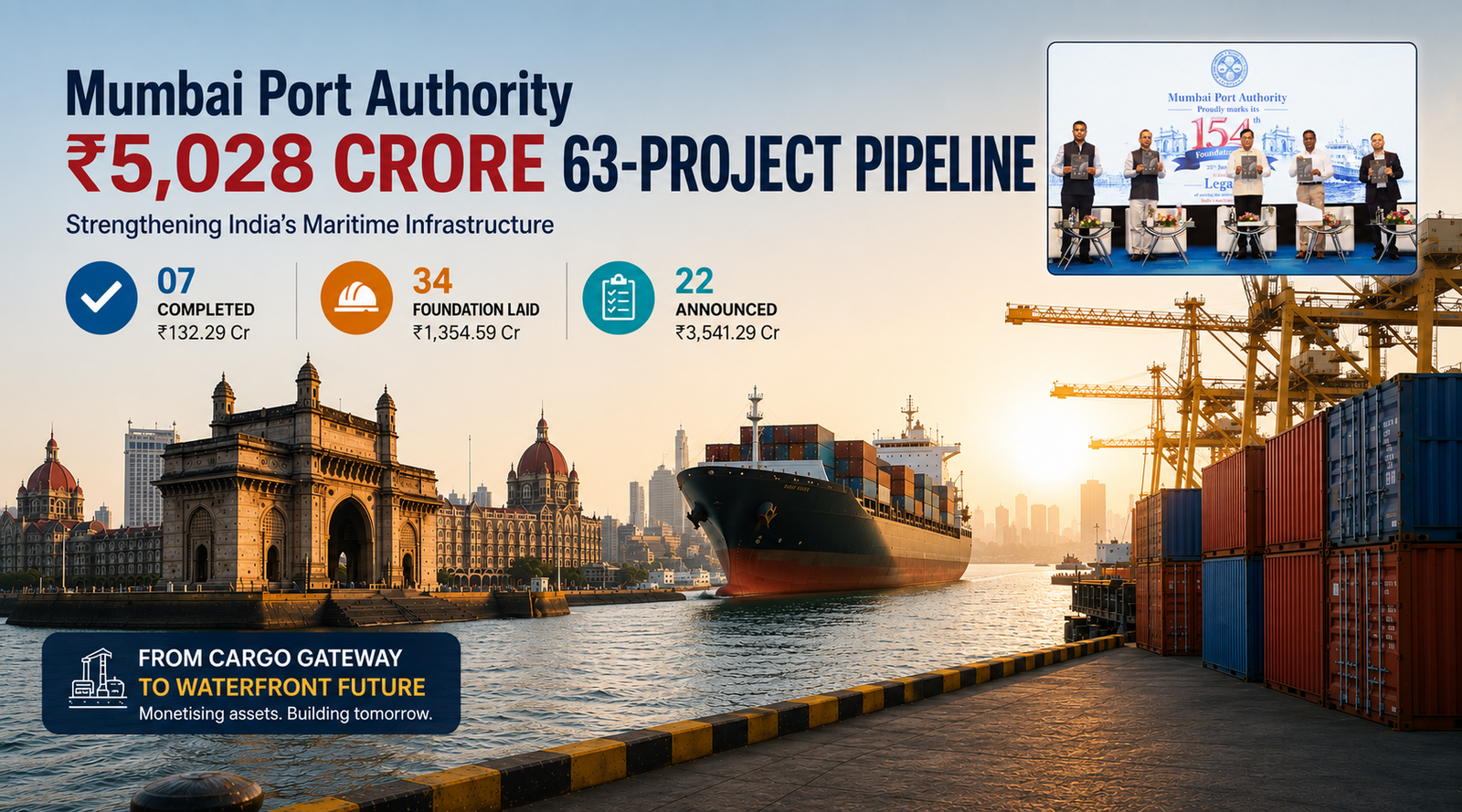
The ₹5,028 crore splits three ways
Of the 63 projects, only seven are finished worth ₹132.29 crore, ready to inaugurate. Another 34, worth ₹1,354.59 crore, got their foundation stones laid at the event. The remaining 22, worth ₹3,541.29 crore, are announcements: still in planning, design or tendering.
That last figure is 70% of the total. It is intent, not concrete.
The projects that exist today berth modernisation at Indira Dock, cargo storage, crude oil berth expansion, solar rooftops, surveillance and digitalisation are real but modest. The headline number is mostly a roadmap.
Indira Dock goes to an operator
Two agreements were exchanged. One develops the Mumbai Marina, a waterfront tourism and recreation project. The other hands operations and maintenance of berth clusters at Indira Dock to an operator, under what the authority itself calls asset monetisation.
This is the move worth watching. A landlord port does not run berths to run berths; it runs them until an operator will pay more to run them better. Indira Dock has 21 berths and a dry dock in the heart of South Mumbai. The land under it is worth more than the cargo crossing it.
The logic is plain once you stop reading the throughput tables. Mumbai Port is India’s largest port by area, and it controls some of the most valuable waterfront in the country. Containers left that estate years ago. What remains is land, oil berths and a coastline and a port authority sitting on that much South Mumbai does not need to win back boxes. It needs a leasing strategy.
ALSO READ:MPCC Buys Four 7,000 TEU Ships, Locks $375M Loan
Mumbai lost the container war to Nhava Sheva
Most of the region’s container traffic now moves through Jawaharlal Nehru Port Nhava Sheva a few nautical miles east, which handles close to half of India’s container volume on its own. Mumbai Port kept the cargo that does not containerise easily: crude and petroleum at the Jawahar Dweep terminal, chemicals at Pir Pau, bulk and general cargo at the docks.
That JNPT’s chairperson sat in the audience for a neighbour’s foundation day tells you the rivalry is settled. The two ports are not chasing the same ship. One handles the boxes. The other is turning into something closer to an energy terminal with a marina attached.
Sonowal placed the day inside the wider national story Sagarmala, Maritime India Vision 2030, the Amrit Kaal Vision 2047, average port turnaround time down to 26 hours from 96, the seafarer count up about 173% since 2014. Mumbai Port is a small line in that ledger now. Its value to the state is increasingly what its land can become, not what its cranes move.
What this means for trade and compliance
For anyone routing containerised cargo through the region, nothing here changes , Nhava Sheva and Mundra remain the gateways, and Mumbai Port’s container relevance is not returning.The monetisation route taken here will set a reference point for how India’s older major ports trade operational control for capital.
The agreement that matters already happened. Once a major port hands one berth cluster to an operator and calls it monetisation, the rest tend to follow the precedent is the point. Expect more of Mumbai Port’s operational footprint to shift to concession over the next two to three years, and more of its acreage to be reclassified from cargo to waterfront.