
Kandla just set a single-day cargo record.
Deendayal Port Authority moved 7.78 lakh tonnes of cargo through Kandla on June 26, the highest single-day total any Indian port has recorded.
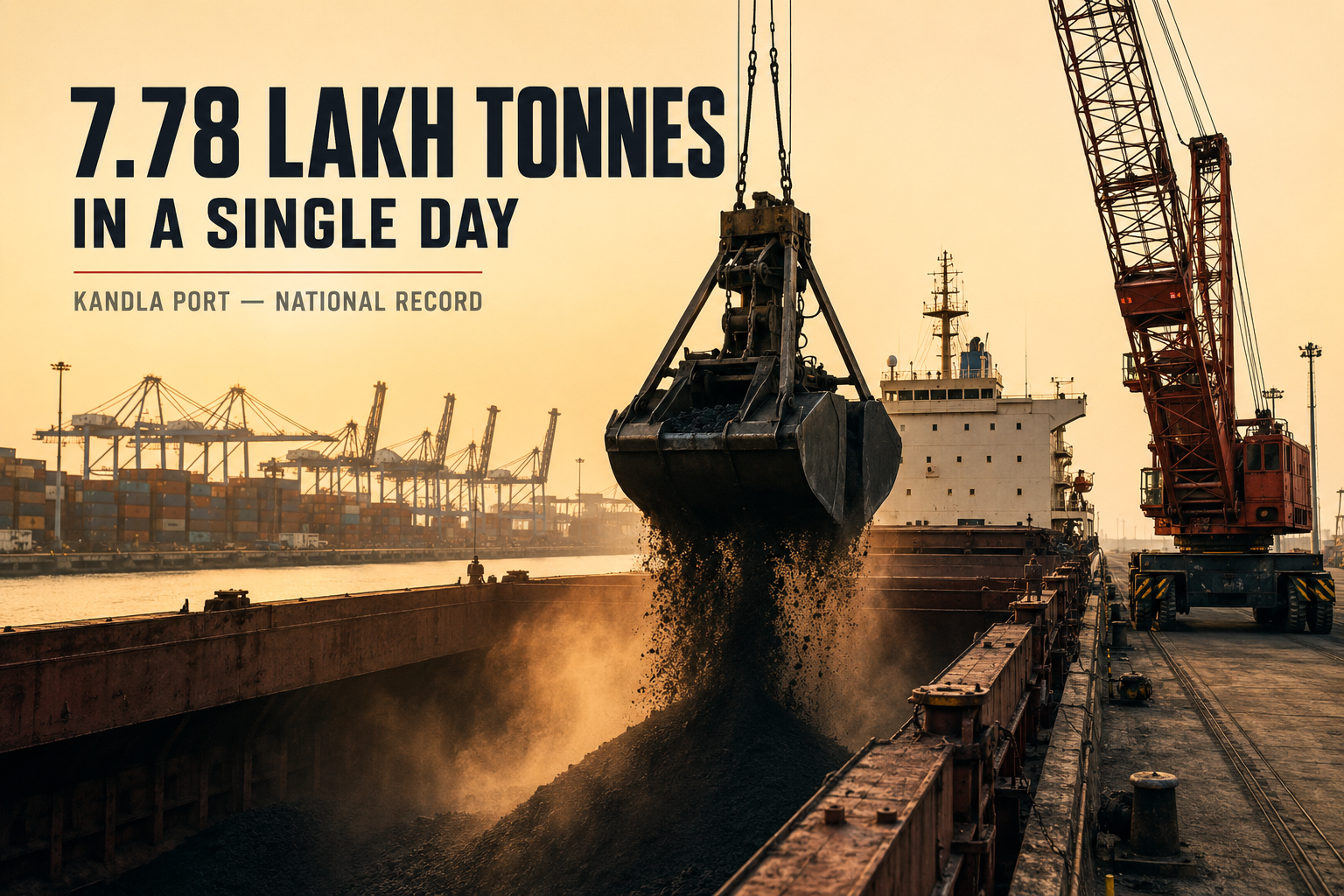
The figure lands three months after the same port closed FY2025-26 as India’s largest major port by volume, at 160.11 million tonnes. A 24-hour peak is a different kind of claim from an annual one. The gap between them is where the interesting reading sits.
The single-day figure is close to 1.8 times Kandla’s own daily average
Spread 160.11 MMT across a full year and the port runs at roughly 4.39 lakh tonnes a day. June 26 ran at 7.78 lakh. So the record day did almost 1.8 times what a normal day does.
That is a real achievement on the quay. But a port’s throughput is bounded by its slowest link, in sequence: the berth, then the yard, then the gate and the rail behind it. A single-day record tells you the berths moved. It does not tell you the cargo left the port.
Single day records are the cheapest kind to set and the hardest kind to read.
ALSO READ:India to absorb 90% of MSME CBAM compliance cost
Kandla leads India’s major ports, but the category matters
DPA framed June 26 as a national record for single-day handling by any Indian port. Its annual leadership is more precisely stated: among the central government’s major ports, Kandla finished FY2025-26 first, at 160.11 MMT, up 7% from 150 MMT the year before, per DPA’s own year-end release.
The distinction matters for anyone reading the “national” framing literally. The country’s single largest port by tonnage is Adani’s [Mundra](EXIMHQ-INTERNAL: profile of Mundra Port and Adani’s non-major terminal network), a non-major private facility further down the same Gujarat coast, which has already crossed 200 MMT a year. Kandla tops the government’s [major-port category](EXIMHQ-INTERNAL: explainer on India’s major vs non-major port classification). Mundra tops everything.
Containers, fertiliser and liquid cargo carried the year
The annual mix is the more durable signal than any one day. Container traffic grew 54%, fertiliser 32%, liquid cargo 23.4%, iron and steel 43%, clay 17%. Against that, coal slipped 2.8%, salt 12.4%, timber 4.3%, and crude and POL at the Vadinar terminal 5%. The growth categories more than covered the declines.
Kandla was built in the 1950s to give a newly independent country a western gateway after Karachi went to Pakistan in 1947. The northern hinterland it was created to serve is the same hinterland whose rail and road capacity now decides whether a day like June 26 means anything beyond the press release.
For anyone routing fertiliser or container volume through Kandla, the operational read is straightforward: berth productivity has stopped being the binding constraint. Inland connectivity is the constraint now. The Ministry of Ports, Shipping and Waterways pointed at exactly this layer with the launch of its Logistics Port Performance Index for FY2024-25 and four aimed at transparency and evacuation visibility across the shipping chain. Kandla’s May recognition, the Sagar Aankalan Award for container handling under 0.5 million TEUs, sits in the same frame.
DPA has already named its next number: 170 MMT, alongside India’s first methanol bunkering trial. Given the cadence of these announcements, fastest major port to 100 MMT, the 160.11 MMT close, now a single-day record, the next milestone is effectively already on the calendar. The constraint on whether 170 actually arrives is not the quay. It is rail capacity to the northern hinterland, and that is the figure worth watching, not the next 24-hour headline.