
Maersk has told customers that Amazon River navigation restrictions could begin in week 41 and close the river to Manaus in November, disrupting cargo to and from the port from October 2026 into early 2027.
The warning rests on an initial advisory from the Western Amazon River Authority and gauge data from Brazil’s National Water Agency, ANA. Both point the same direction: a high likelihood of reduced draft and possible closures during the low-water season. Manaus is not a port with a river attached. It is a port that exists only because of the river, and the water arrives on its own schedule.
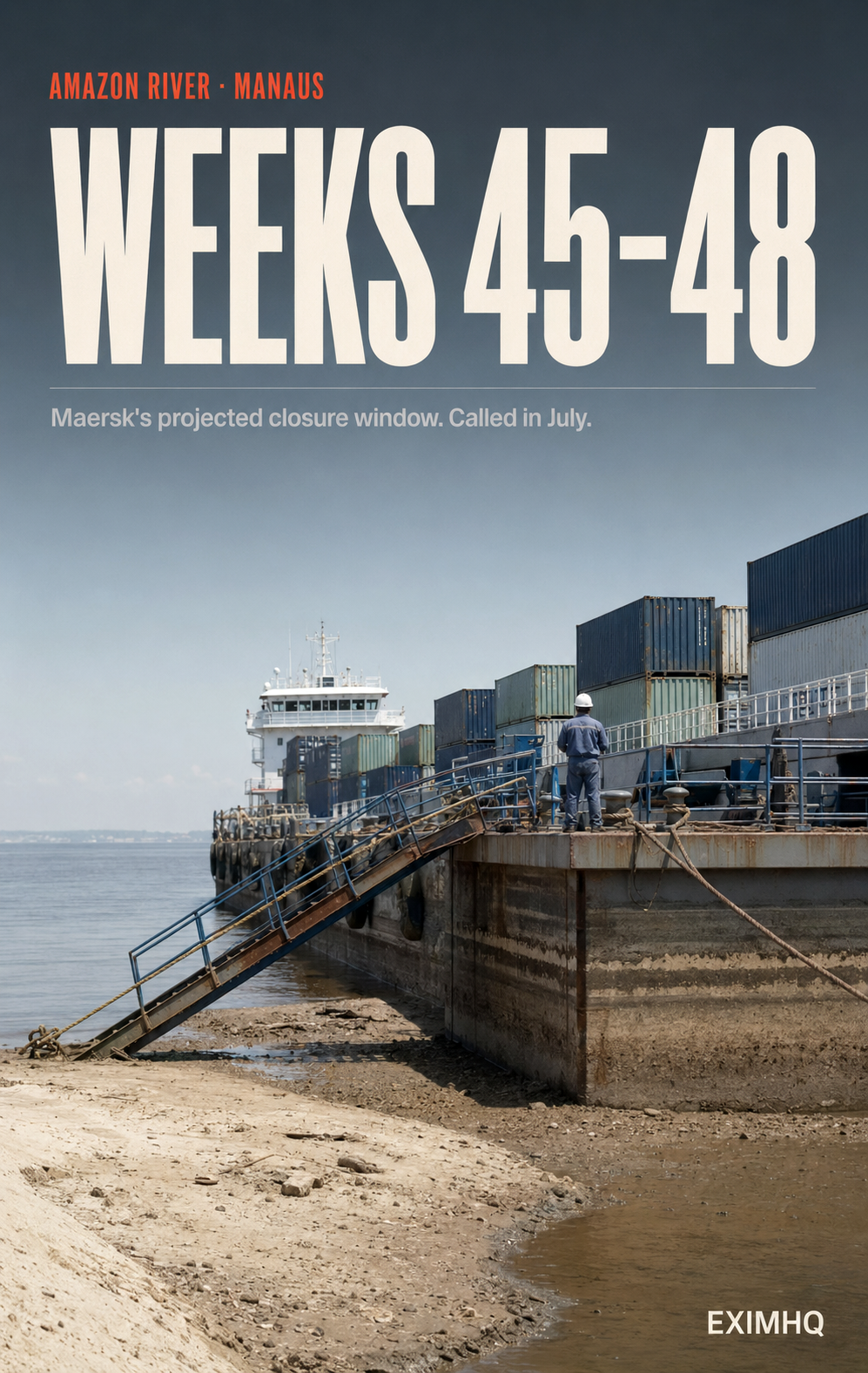
Maersk has drawn the closure window at weeks 45 to 48
Maersk’s projections split the dry season into three phases. Vessel capacity restrictions could begin between weeks 41 and 44, covering October. A possible river closure follows in weeks 45 to 48, through November. Capacity restrictions then run again from weeks 49 to 53, into the end of December.
The carrier has also flagged what happens if conditions deteriorate past that. Floating piers come into play, freight rates may move, and an additional surcharge could be introduced. Anyone who has shipped into Manaus since 2022 knows what that means in practice. The Low Water Surcharge has been levied in every serious drought year, and in August 2024 it was applied across Aliança, Log-In, ONE, Mercosul Line and MSC within weeks of each other.
Maersk says it continues to monitor water levels and will update customers as conditions develop.
The Rio Negro has broken its own record twice since 2023
The Rio Negro at the Port of Manaus fell to 13.49 metres on 17 October 2023, the lowest reading since the gauge was established in 1902. Then it fell further. On 4 October 2024 the same gauge read 12.66 metres, against a normal October level of roughly 21 metres, breaking a record that was itself only a year old.
Both years produced the same operational sequence. Direct liner calls at Manaus were suspended, CMA CGM diverted its Manaus Shuttle vessels to Fortaleza in October 2023, and cargo moved by a truck-and-barge patchwork out of Vila do Conde. Then 2025 delivered the opposite extreme, with the Negro cresting at 29.05 metres, above the severe flood threshold, and among the twenty largest floods on the Manaus record.
Three of the last four years have been at one hydrological extreme or the other. That is the risk profile the Manaus Industrial Hub now runs its inbound components against.
ALSO READ:Maersk orders 1,000 more India-made containers
Dredging, not rainfall, is the variable Brazil controls
Draft is not a soft constraint. A vessel either has water under the keel at the critical passages or it does not, and the two that decide Manaus access are the Tabocal passage and the mouth of the Madeira, both of which silt up faster than they are cleared. Lose the draft and the vessel loses payload. Lose enough payload and the call stops paying for itself, at which point the cargo shifts to a floating pier at Itacoatiara and picks up an extra handling leg, extra coordination, and extra cost. Maersk’s 2025 advisory set the trigger for full offload at Itacoatiara at 15.39 metres. The surcharge is not opportunism. It is the arithmetic of a discharge operation that now takes two moves instead of one.
Which makes dredging the only lever with a human hand on it. Gabriela Costa of the Association of Private Port Terminals has argued that dredging a working waterway is maintenance, not new construction, and should sit in the infrastructure budget rather than the emergency one. The Brazilian Association of Cabotage Shipowners has pushed for work in the critical stretches to start as early as August, ahead of the peak. A recent Federal Court of Accounts audit found weaknesses across planning, governance, data collection and execution in Brazil’s waterway system.
Carriers have published a version of this advisory every June or July since 2023. The dredges keep arriving after the water has gone.
The Northern Arc turns a Manaus problem into a national one
The Northern Arc corridor now carries more than 53% of Brazil’s soy and corn flows, on ANTAQ estimates, and its performance depends on inland waterway navigation. Barges, transshipment points, storage, floating structures and ocean-going tonnage function as one chain. When the river drops, the constraint does not stay in Amazonas.
Forecasters are not offering comfort. A joint technical note from INPE, INMET, FUNCEME and CENSIPAM indicates a high probability of El Niño conditions developing in the coming months, with NorthStandard’s Brazil correspondent flagging the possibility of a Super El Niño in the second half of 2026 and effects running into 2027. In the Amazon that pattern means less rain, lower rivers, and a shorter navigation window the same signature as 2015/2016 and 2023/2024. At federal level a situation room coordinated by the Chief of Staff’s Office is already standing up.
Brazil’s dredging contracts do not mobilise inside a quarter, which means the floating-pier contingency is already the plan of record for this season whatever gets announced in the next six weeks. The surcharge follows the pier. Expect the other Manaus operators to file their own low-water surcharges within weeks of Maersk’s, before restrictions actually bite that was the 2024 sequence, and nothing in the incentive structure has changed since.
FAQ
When will Amazon River navigation restrictions to Manaus start in 2026?
Maersk projects vessel capacity restrictions beginning between weeks 41 and 44, which covers October 2026. A possible closure follows in weeks 45 to 48, with further capacity restrictions from weeks 49 to 53. The carrier’s advisory covers disruption running into early 2027.
Will a low water surcharge apply to Manaus cargo this season?
Maersk has said an additional surcharge could be introduced if conditions worsen to the point of floating pier operations or temporary closure. Every severe drought year since 2022 has produced one, and in August 2024 five carriers serving Manaus applied it in close sequence.
What actually stops vessels reaching Manaus?
Silting at the Tabocal passage and the mouth of the Madeira River reduces available draft at the critical crossing points. Maersk’s 2025 advisory set full offload at the Itacoatiara floating pier at a level below 15.39 metres, after which cargo completes the journey by barge.