
Maersk has ordered 1,000 more India-made shipping containers from DCM Shriram Group, placed on Friday at the Dadri inland container depot in Uttar Pradesh as India’s first export-import container built for a global carrier rolled off the line.
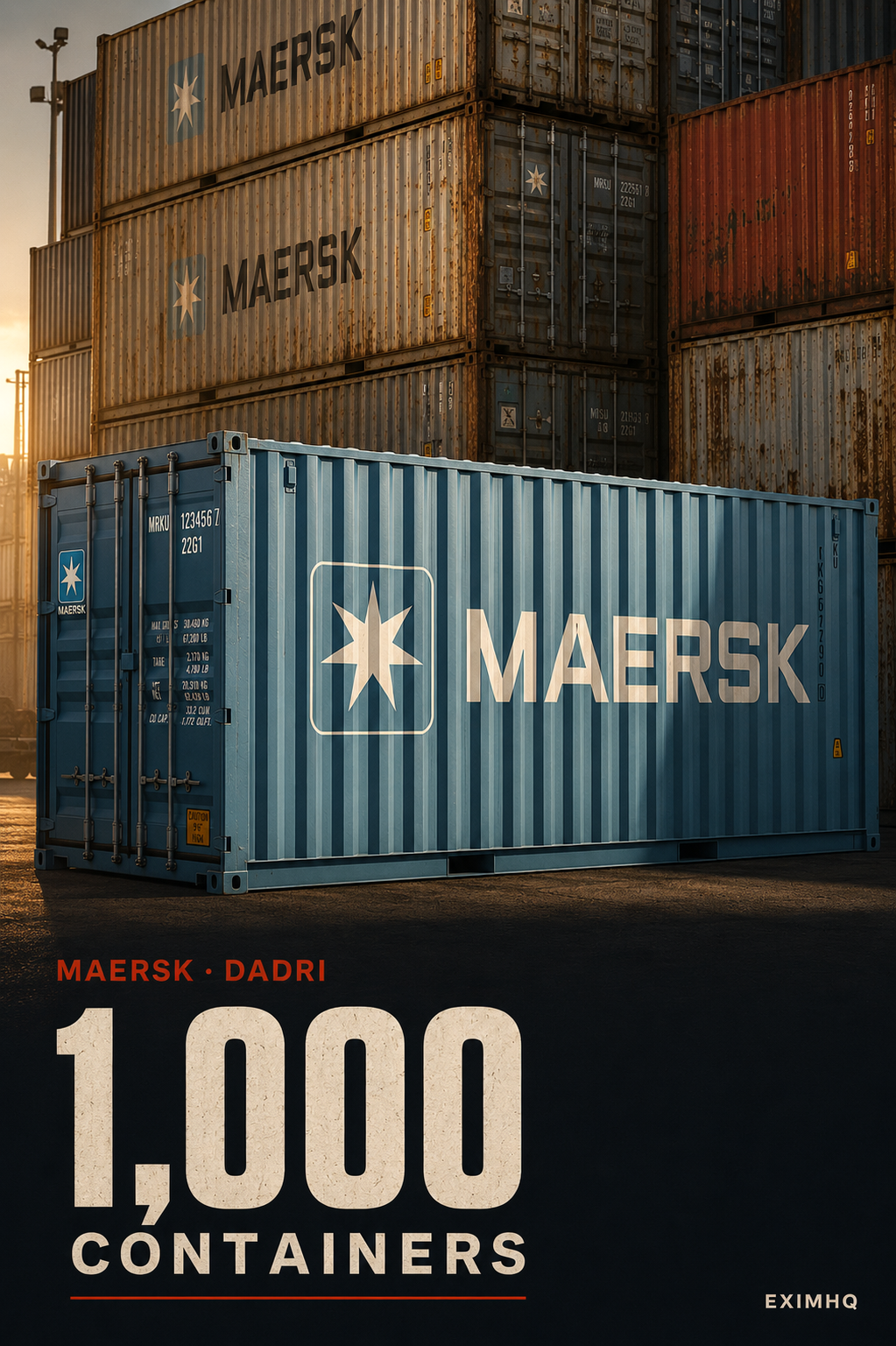
The box is the one piece of global trade India has never made at scale. Nearly every container moving through an Indian port arrives on the water having been built somewhere else, most of them in China. That is the dependence this order is meant to start unwinding.
First India-built EXIM box at Dadri
Union Minister Sarbananda Sonowal unveiled the container at the Maersk-CONCOR inland container depot in Dadri, and Maersk placed the 1,000-unit order with DCM Shriram during the same event. The Ministry of Ports, Shipping and Waterways called it the start of a long-term commercial partnership, and Sonowal called it a defining milestone in India’s push toward Atmanirbhar Bharat.
The guest list said something too. The Netherlands ambassador, Marisa Gerards, stood alongside Maersk managing director Thomas Theeuwes and senior vice president Ahmad Hasan. A container unveiling does not usually pull an ambassador. This one did.
India-made shipping containers now meet ISO and CSC standards
The first India-made unit was produced to ISO specifications and the International Convention for Safe Containers, the ministry said, which is the threshold a box has to clear before any carrier will let it into a global rotation. Quality was never really the question. Cost is.
That distinction matters. A container that meets CSC can be loaded anywhere; a container that meets CSC and costs what a Chinese one costs is the only kind that survives without help.
ALSO READ:Maersk Eyes India-Made Containers Over China
A Rs 10,000 crore scheme underwrites the cost gap
The order lands under the Rs 10,000 crore, announced in the Union Budget 2026 to build a domestic container industry from almost nothing. The scheme offers capex support for new greenfield plants and brownfield expansion, funding for R&D, and, the revealing part, opex support to “bridge the cost gap per container.”
Read that last line closely. The government is not subsidising India into a cost advantage it already has. It is paying down a cost disadvantage it knows exists.
India imports nearly all of its containers today, most of them from China, which builds the overwhelming majority of the world’s boxes out of integrated steel supply and decades of clustered scale. Breaking into that is not a quality problem. It is a scale and steel problem, and scale is exactly what a first order of 1,000 does not provide.
What this means for a China-built container supply chain
Maersk is one of the three largest container lines in the world, and it chose to source in India rather than settle for a symbolic handshake. That is the real signal here, not the box. Real procurement.
But Maersk also drew the line in its own statement. It framed the milestone as the foundation of a supply relationship that grows only as Indian manufacturers keep meeting global quality standards “at competitive costs.” Translation: the order scales if the price works, and stalls if it doesn’t. Maersk has told India the condition out loud.
The arithmetic is simple enough. As long as the opex subsidy covers the gap between an Indian box and a Chinese one, the Indian box competes. When the subsidy tapers every such scheme tapers the box competes only if the underlying gap has closed. Steel, scale, throughput. Nothing about the ribbon-cutting changes that math.
India has run this play before, in electronics assembly and solar, where subsidy-led import substitution held for as long as the subsidy did and got tested the moment it thinned. Containers will follow the same arc. Watch the second and third orders, not this one, and whether they come in at a price Maersk would pay without Delhi topping it up. The first 1,000 boxes prove India can build one. The next ten thousand will prove whether it can build them cheap.