
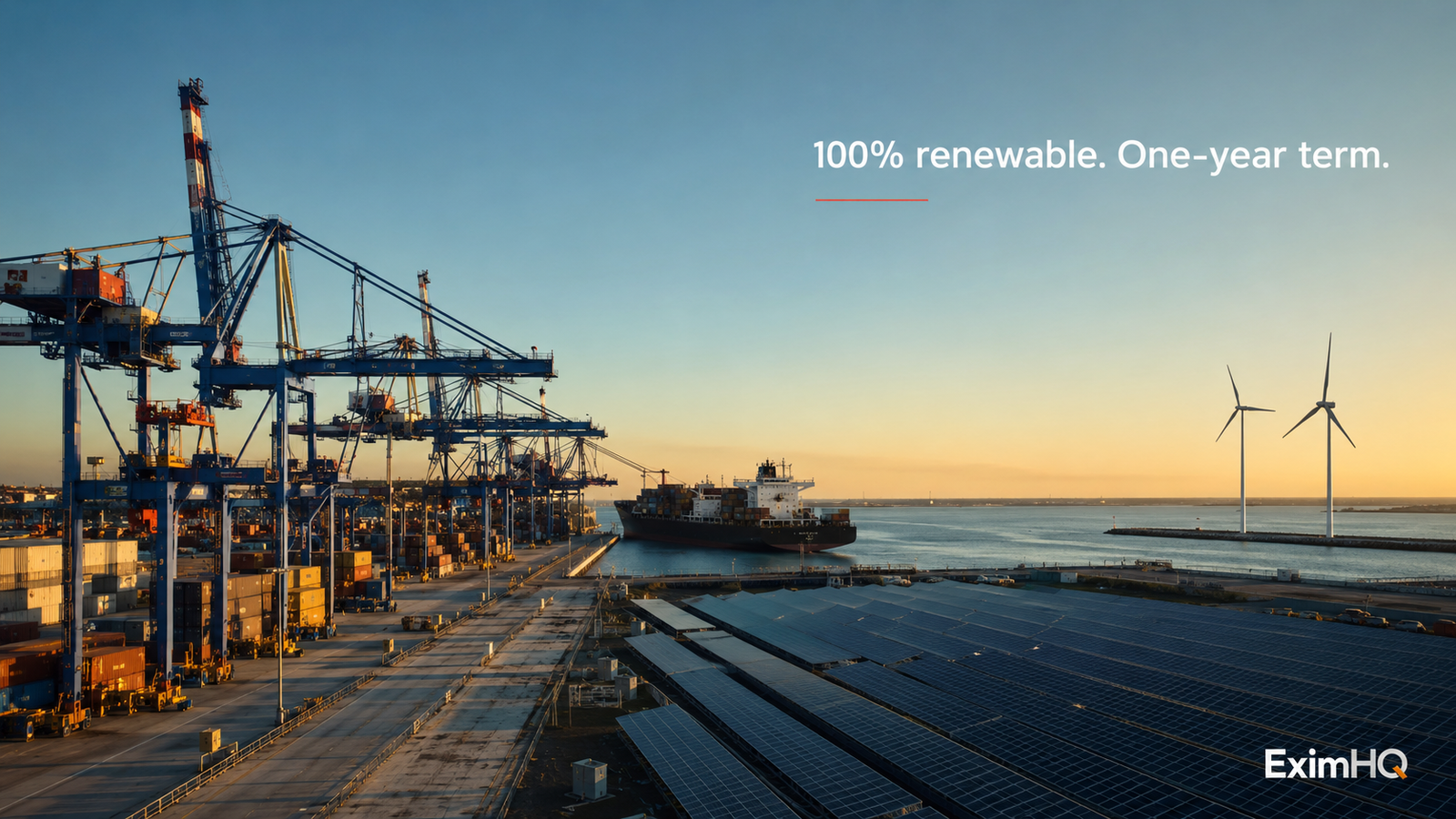
Suez Canal Container Terminal will source all of its electricity from solar and wind under a power purchase agreement signed with Egypt’s New and Renewable Energy Authority, making one of the region’s busiest gateways among the first fully renewable-powered ports in the country.
The deal was signed at the Cabinet headquarters in Cairo, with Prime Minister Mostafa Madbouly present. The state turnout was the tell. Egypt does not send its prime minister to a routine utility contract, and the government has been stitching renewable capacity into the Suez Canal Economic Zone since COP27, when the same zone signed eight clean-energy contracts in a single stretch.
The agreement took more than two years to structure
This was not a quick signature. It is the result of coordination between SCCT, the Suez Canal Economic Zone, the Ministry of Electricity through NREA, and the regulator EgyptERA work that ran for more than two years before the document was ready.
That length matters. A single terminal buying green power is a procurement decision. A structure that four state bodies spent two years aligning is meant to be copied. SCCT and SCZONE have said as much: the agreement is designed so other Egyptian port operators can replicate it as the country pushes its renewable targets forward.
SCCT sits at the mouth of the canal, which is the point
SCCT operates at Port Said East, at the northern entrance to the Suez Canal, and it is majority owned by Maersk’s APM Terminals. In 2024 the World Bank and S&P Global ranked it the third most efficient container port in the world. This is not a marginal facility running a pilot. It is a top-tier transshipment hub choosing to run entirely on renewables, which is what gives the template its weight.
Keld Mosgaard Christensen, SCCT’s CEO, framed it as a proof point for what industry and government can do together on energy. The more useful read is structural: a gateway of this size committing to renewable power sends a signal to every other operator in the zone about where the baseline is heading.
ALSO READ:Kongsberg Maritime leads EU wind propulsion project
The emissions math, and the one-year catch
Once in effect, the agreement is expected to eliminate roughly 30,000 tonnes of CO2 a year by swapping fossil-based grid electricity for solar and wind. APM Terminals puts that at about 6% of its group emissions against baseline a real number for a single site.
But read the term. The initial agreement runs for one year, with an option to renew. For a two-year negotiation between four government entities, a twelve month term is short, and it tells you this is a first iteration built to be extended rather than a settled, decade-long supply contract. The structure is the product here. The one-year clock is how everyone keeps their options open while the template proves itself.
What this means
For a compliance or sustainability lead at any APMT competitor operating in Egypt, the relevant fact is not the 30,000 tonnes. It is that a replicable purchase structure now exists, vetted by NREA and EgyptERA, that a port operator can point to. The regulatory path has been walked once. That lowers the cost of walking it again.
The wider APMT target sits behind all of it. The company is working toward 100% renewable electricity by 2030 and net-zero across its value chain by 2040, and it already sources about 62% of its power from renewables globally. SCCT moving to 100% is one of the larger single steps in closing the remaining gap.
If it renews on similar or better terms, expect at least one other SCZONE operator to sign a comparable deal within the following year the whole point of spending two years on a structure is that the second signatory should not need two more. Egypt has staked visible political capital on the zone’s green transition, and a government that puts its prime minister in the room does not build a template it intends to use once.