
CMA CGM India has opened a new weekly export block train from the Garhi Harsaru inland container depot in the National Capital Region to Mundra Port, running every Thursday at up to 180 TEUs a train. It is the carrier’s eighth weekly block train into Mundra.
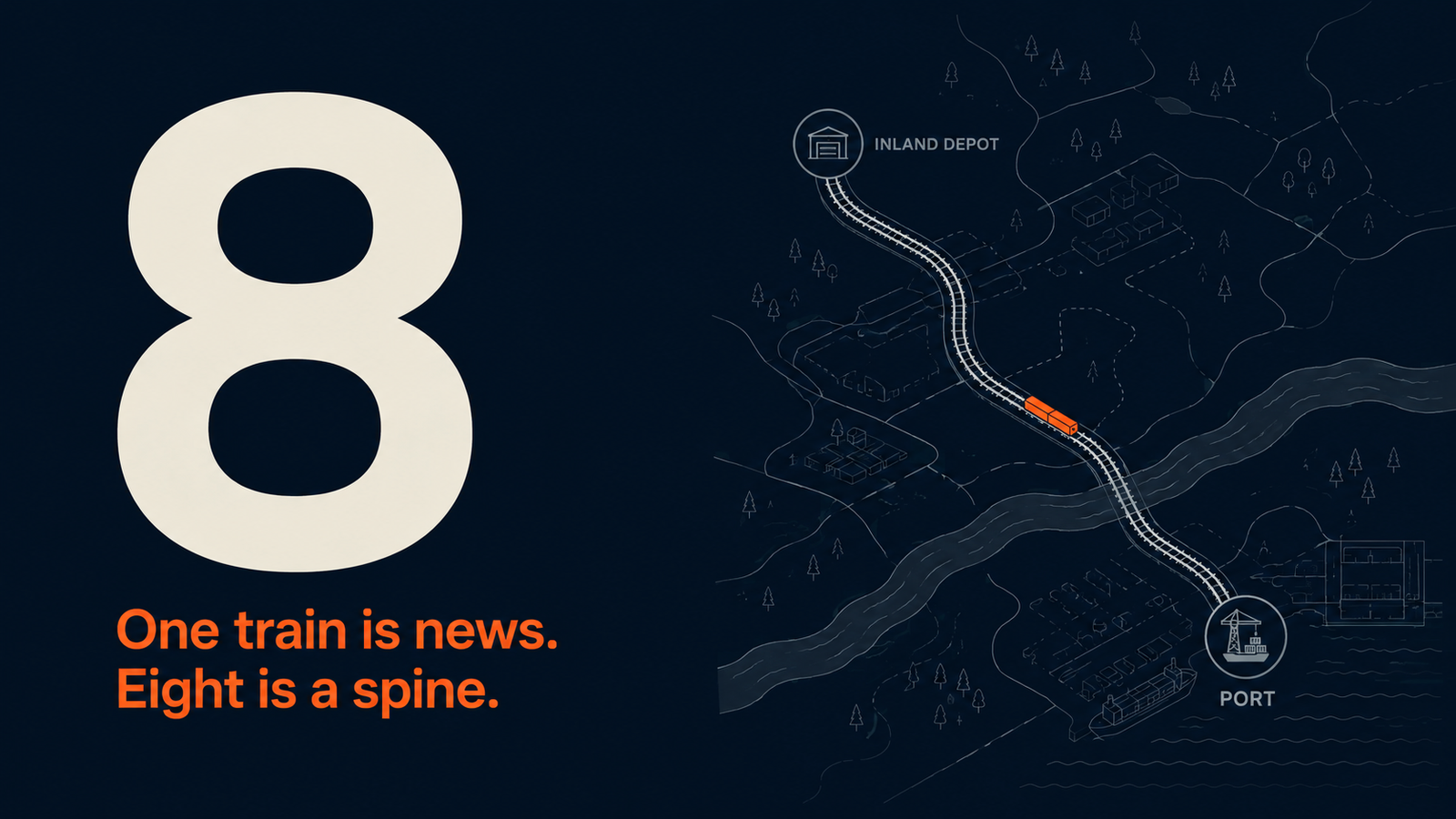
CMA CGM now runs eight weekly block trains into Mundra
The Garhi Harsaru service departs every Thursday with a carrying capacity of up to 180 twenty-foot equivalent units. Fixed weekly slots, a single inland origin in the NCR, one destination gateway. The pitch to exporters is predictability: a known departure day they can plan production and documentation around, rather than chasing road haulage availability into Gujarat.
With this launch CMA CGM India operates eight weekly export block trains connecting inland container depots across North India to Mundra, one of the country’s largest container ports. A carrier does not stand up eight scheduled rail services into a single gateway by accident. It does so when it has decided that the road alternative is the weaker bet.
The service feeds four of CMA CGM’s deep-sea strings
The block train connects directly into INDAMEX, EPIC, MEDEX and MIDAS ,CMA CGM services reaching Asia, the Middle East, Europe and the Americas. The point of a dedicated inland train is not the train. It is the handoff. Cargo loaded at Garhi Harsaru on Thursday is moving toward a deep-sea string without the dwell time and uncertainty that road drayage into a congested port introduces.
The launch was carried out with Gateway Distriparks Limited, the inland logistics operator running the depot end. This is the standard division of labor in Indian multimodal: the liner owns the ocean leg and the relationship with the exporter, the distripark operator owns the rail and terminal mechanics inland. Neither does the other’s job well alone.
ALSO READ:Maersk Eyes India-Made Containers Over China
Rail-led logistics is policy, and carriers are reading the policy
India has spent years pushing to lift rail’s share of freight off a road-dominated base, on the logic that rail moves a container cheaper, more predictably, and with a fraction of the carbon per tonne kilometre. Block trains are the instrument: a full train of containers moving point-to-point on a fixed path, no marshalling, no mid-route reshuffling.
The mechanics are simple enough to see in one line. A block train carries up to 180 boxes on one path on one schedule; the road equivalent is 180 separate truck movements, each with its own driver, its own delay risk, its own fuel burn. Consolidate the movement and the per-container cost and emissions both fall. That is the entire case for rail-led freight, and it is why the modal-share target exists.
Carriers respond to that the way carriers always respond when the cheaper, more predictable option also happens to align with the policy direction, they move capacity toward it. Eight weekly trains is what reading that signal looks like.
What this means for trade and compliance teams
For exporters and their compliance teams in North India, the operational variable that changes is dwell and predictability, not price headline. A fixed Thursday departure with a known capacity lets a shipper sequence customs filing, factory stuffing, and gate-in against a calendar rather than against road-haulage availability. The risk that shifts is timing risk: a missed Thursday slot now means a full week’s wait, not a same-day reroute by truck. Tighter schedule discipline inland is the trade-off for the predictability.
For anyone watching the Mundra gateway, the signal is concentration. CMA CGM is building inland feed into one port rather than spreading bets, and the eighth train says that decision is settled, not experimental.
CMA CGM has now committed scheduled rail capacity into Mundra at a scale that is expensive to unwind eight weekly paths, depot relationships, slot commitments with the rail operator. Carriers that build this kind of inland spine rarely dismantle it; they thicken it. The likeliest next move is a ninth and tenth service, and a competing line answering with its own block-train ramp into the same gateway before the freight base gets locked to a single carrier’s schedule.