
The Centre is working on a scheme to cover 90 per cent of the CBAM compliance bill for India’s small exporters a cost industry pegs at ₹15–20 lakh per unit as the EU’s carbon tax enters its first payment year.
The relief, is under preparation, would soften a burden that has already landed unevenly. India tried to win a concession for its small industries in talks with developed economies. That effort failed. So the cost now sits where the regulation put it: on the firms least equipped to carry it.
Compliance, not the carbon levy, is what breaks the small exporter
The levy itself is not the problem most micro and small units cannot survive. The reporting around it is.
To clear CBAM, an exporter must track the embedded emissions of every good shipped to the EU direct emissions, and for sectors like cement and fertilisers, indirect ones too. That means carbon accounting, third-party verification, digital reporting systems, and staff who understand all three. A large steelmaker spreads those costs across millions of tonnes. A fifteen-worker forging shop spreads them across almost nothing.
The arithmetic is brutal because the cost is fixed. Industry sources put it at ₹15–20 lakh per unit to meet the carbon-tax reporting requirement, and that figure does not fall as the business gets smaller. It is the same bill for a billion-dollar mill and a workshop on the edge of Rajkot. The mill can absorb it. The shop cannot. A fixed compliance cost is a regressive tax wearing a neutral one’s clothes.
Ayush A Mehrotra, Partner at Khaitan & Co, frames the point precisely: the principal challenge under CBAM is not the carbon charge but the cost of complying with it and because those costs are largely fixed, smaller exporters bear a disproportionately heavier load that could price them out of the EU entirely.
ALSO READ:CMA CGM Adds 8th Weekly Block Train to Mundra Port
Default values turn missing data into a penalty
The regulation has a trap built in, and it is the one most likely to catch an unprepared MSME.
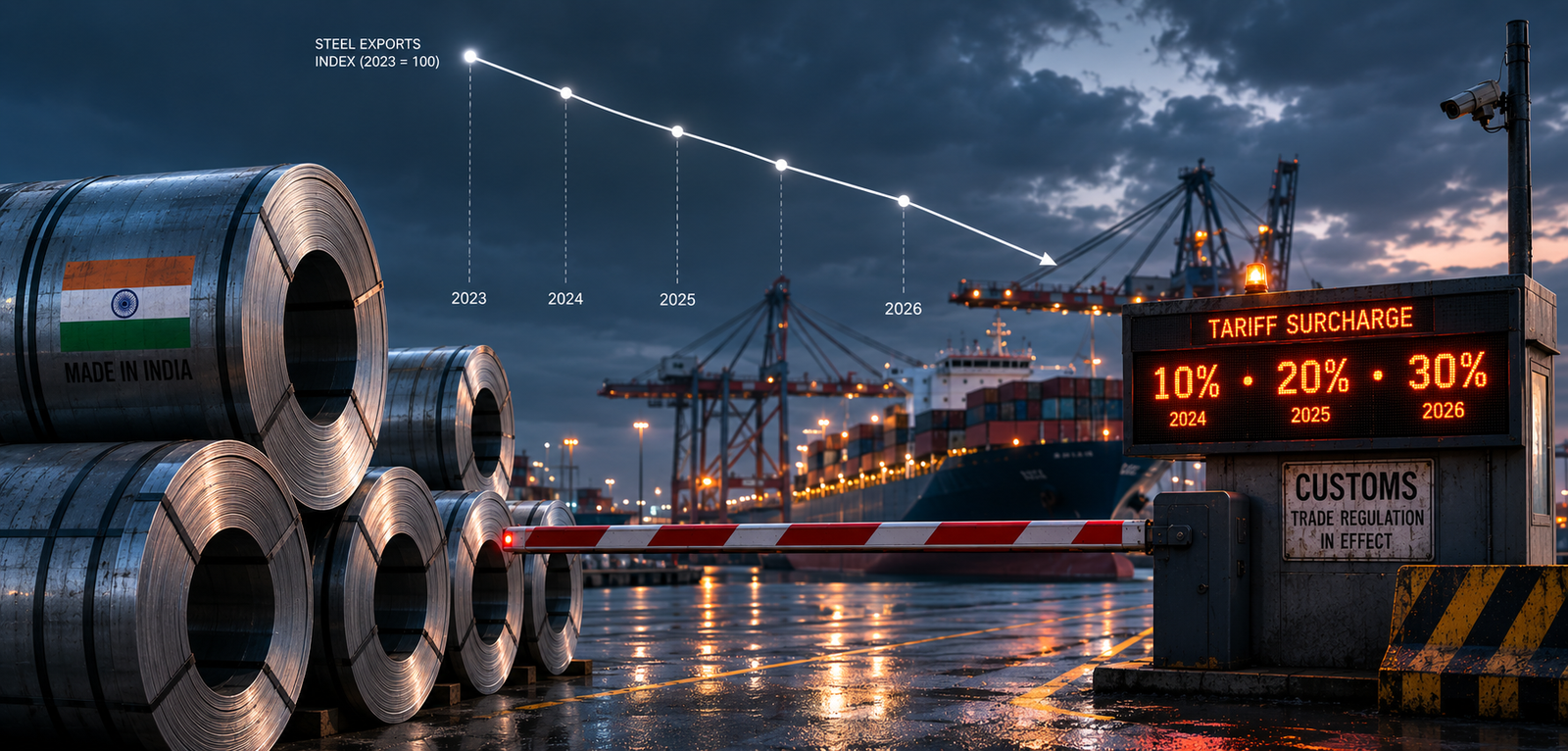
If an exporter cannot supply actual emissions data, the importer must apply the European Commission’s “default values” and those defaults carry a deliberate mark-up so embedded emissions are never understated. The mark-up climbs on a fixed schedule: 10 per cent in 2026, 20 per cent in 2027, and 30 per cent from 2028. The less data a firm can produce, the more it pays. And the firms least able to produce verified emissions data are precisely the small ones the scheme is now trying to rescue. ICRIER models a 24 per cent hit to EU steel shipments
The macro picture matches the micro one. A working paper from the Indian Council for Research on International Economic Relations (ICRIER), released this month, runs CBAM through its Samriddhi Trade general-equilibrium model and finds the iron and steel sector absorbs the worst of it: Indian I&S exports to the EU could fall by about 24 per cent.
Fertilisers and aluminium follow, then metal products. Across all markets, India’s global iron and steel exports decline 5.7 per cent against just 1.2 per cent for China, whose lower-carbon production and domestic carbon market leave it far less exposed at the EU border.
The sharpest finding is the one Brussels will least want to discuss. ICRIER concludes that CBAM hurts India’s trade with the EU while doing almost nothing for the climate it was built to protect the effect on global emissions is negligible, with the worldwide steel industry shaving roughly 1 per cent. A tax that reshuffles trade without cutting much carbon is doing something other than what it says on the label.
What this means for compliance
For a customs or compliance lead, the operative deadline is not 2026. It is the mark-up ratchet behind it.
A firm that cannot produce verified emissions data this year eats a 10 per cent default-value penalty. The same gap costs 20 per cent next year and 30 per cent the year after. The cost of staying unprepared compounds on a published schedule, which makes the build versus exit decision a near-term one, not a someday one.
India is the world’s second-largest producer of both crude steel and primary aluminium the exposure here is not a niche problem, it is a flagship sector one.
The proposed 90 per cent cost-absorption scheme, if it is notified, changes the calculus for the smallest exporters by converting a fixed entry cost into a near-zero one. Until it is notified, it is a line in a newspaper, not a line item a CFO can plan against.
That single document is worth more to a small exporter than the entire FTA was.
FAQ
What makes CBAM compliance so costly for Indian MSMEs?
The expense is the reporting, not the carbon charge. Industry sources estimate ₹15–20 lakh per unit to track and verify embedded emissions, and because that cost is largely fixed, it does not shrink with the size of the business so the smallest exporters carry the heaviest per tonne burden.
How do CBAM default values penalise exporters who lack data?
If an exporter cannot supply actual emissions figures, importers must use the European Commission’s default values, which carry a built-in mark-up of 10 per cent in 2026, 20 per cent in 2027, and 30 per cent from 2028. The penalty for missing data rises every year on a fixed schedule.
Which sectors does ICRIER expect CBAM to hit hardest?
Iron and steel, where exports to the EU could fall about 24 per cent, followed by fertilisers, aluminium, and metal products. India’s global iron and steel exports are projected to drop 5.7 per cent, against 1.2 per cent for China.