
India’s Directorate General of Trade Remedies opened an anti-dumping investigation on 22 June into cold rolled grain oriented electrical steel and amorphous metal from China, Japan, Korea and Russia, acting on a complaint from JSW JFE Electrical Steel Nashik.
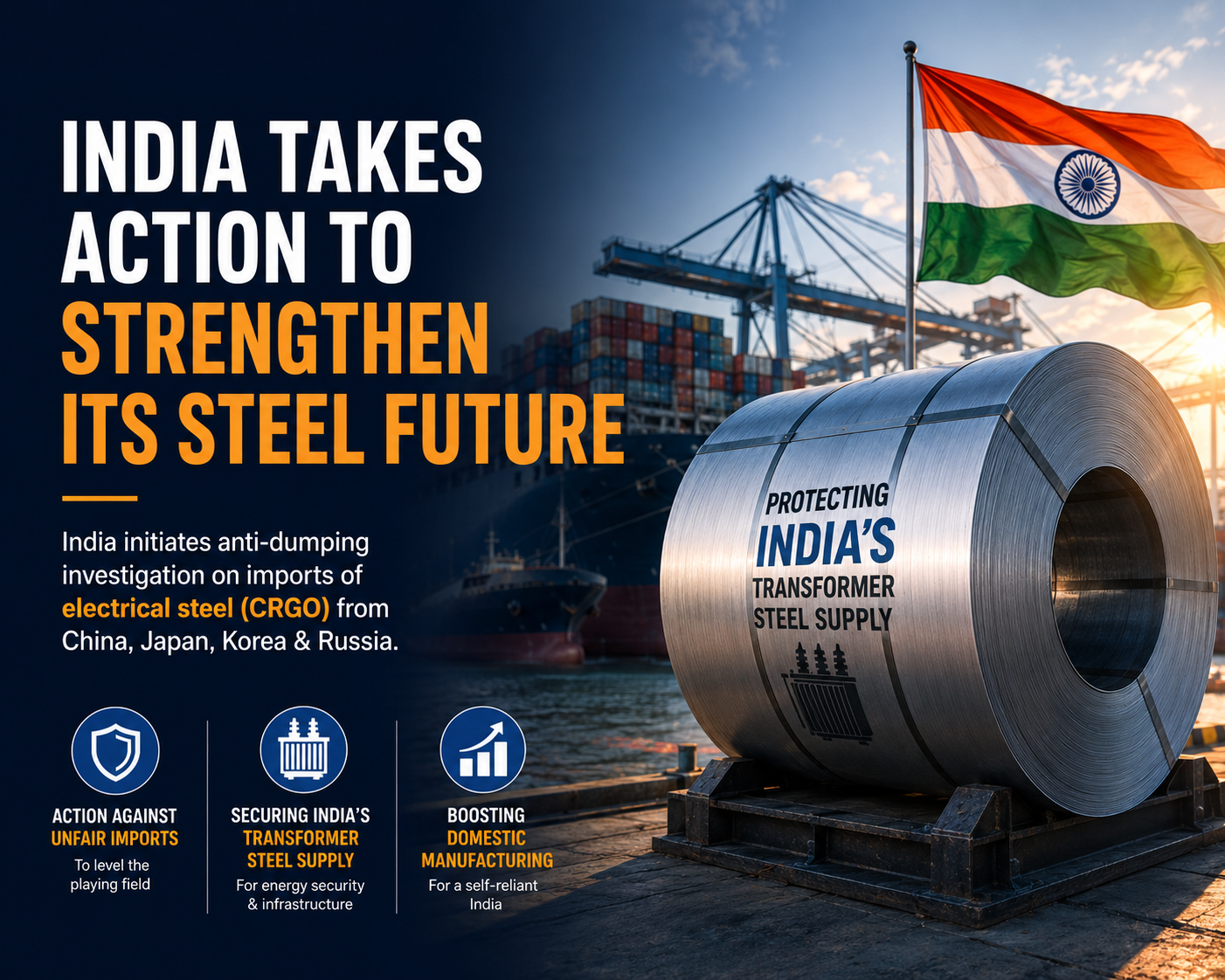
CRGO is the grade transformers are built from. India makes very little of it and imports almost all of it, which is what makes this particular filing worth reading closely.
The applicant is India’s only meaningful CRGO producer
JSW JFE Electrical Steel Nashik filed the complaint with the DGTR, alleging that cheap imports of grain oriented steel and amorphous metal are injuring the domestic industry. Satisfied with the prima facie evidence, the authority said it would establish whether dumping exists, how large it is, and what injury it has caused. If it finds material injury, it recommends a duty. The Finance Ministry takes the final call.
The applicant is not a bystander in this market. It is the market. (JSW Steel and Japan’s JFE Steel bought the former Thyssenkrupp plant at Nashik in January 2025 and made it a 50:50 joint venture.) At roughly 50,000 tonnes a year, it supplies something like a tenth of what India consumes.
India imports close to 85% of the CRGO it needs
National CRGO demand runs around 400,000 tonnes a year. Domestic output covers 50,000 of that. The rest, near 240,000 tonnes in a recent year, arrives from China, Japan, Russia and South Korea.
Those are the four countries on the notice.
File an anti-dumping case and you file it against the suppliers you actually buy from, not the ones you might. India buys its grain-oriented steel from these four and almost nowhere else, because only ten to twelve companies worldwide make it and the process is guarded.
ALSO READ:India FTA Rules of Origin 2026: Duty Lines, CoO, Compliance
A Japanese owned producer wants Delhi to tax Japanese steel
JFE Steel of Japan owns half the company that filed the complaint. Japan is one of the four countries the complaint targets.
That looks like a contradiction. It isn’t. JFE’s bet in India is to roll CRGO at Nashik rather than ship it in from Japan, and a duty on imported grain-oriented steel, Japanese tonnes included, pushes Indian transformer makers toward the India-made coil. The tariff does not cut against JFE’s interest. It is JFE’s interest, onshored.
The duty would arrive before the domestic capacity does
JSW JFE is mid-build. Nashik is being taken from 50,000 to 250,000 tonnes, and a second line at Vijayanagar in Karnataka lifts the combined target near 350,000 tonnes, at a capital outlay of ₹5,845 crore. None of it is fully online before FY2028.
Until then the arithmetic holds: India still has to import the overwhelming majority of the steel that goes into its grid.
For the people who actually buy this steel transformer manufacturers supplying utilities, industrial users and renewable projects — the live question is not whether a duty is coming but when, and in what form. The investigation precedes any levy, and a finding is months out.
There is a recent template. In December 2025 the same authority put a five-year anti-dumping duty of $223.82 a tonne on Chinese cold-rolled non-oriented electrical steel, CRNO, the sister grade used in motors and small transformers. Same product family, same logic, six months apart. Procurement teams pricing transformer cores into 2027 contracts would do well to assume a duty on at least the Chinese tonnes and build the band in now.
A duty is the likely outcome. The harder question is how it gets calibrated, because you cannot tariff 85% of a supply you do not yet make without raising the cost of every transformer India installs between now and FY2028.